Two, Dos, Deux: as easy as 1, 2, 3

Most people know how to say “two” in Spanish: “dos.” Rhymes with “close,” as in, “Close to You.”

Since my novel MAKE THAT DEUX was published, however, I’ve only heard a few who know how to say “two” in French: “deux.” Rhymes with…hmm.

I can’t think of a rhyme in English that doesn’t have a consonant ending, like “could,” “look,” or “put.” But you can pronounce“deux” – even if you took didn’t take French in high school. N’ayez pas peur (don’t be afraid): make it rhyme with one of the above, leave off that consonant sound, and you’ve got it.
photo

The third word of my novel’s title, taken from the Cover

For a writer, choosing a title for your book is kind of like naming your baby: usually, you give it some serious thought, and it’s not always facile (easy). When you’re writing a novel and you tell others (prematurely) what you’ve decided to name your  baby book, you want to hear them say, “That’s great!” not “Really?”

But once you’ve published your book, the baby’s been born and a name title given. People do in fact say “That’s great!” or even “I love it!” – no matter what they think. They don’t feel as free to tell you their opinion; if they can’t say something nice, they don’t say anything. Plus, like baby names, I believe that titles grow on people, and they come to fit the baby novel. At least, people look for reasons why names titles fit. As a writer, I love it when they find them.

But when people aren’t sure how to pronounce your book’s title (perhaps because you’ve chosen a word from another language?), there could be a problem.

I’ve heard the troisième word of my novel’s title (mis)pronounced as “do” most often. But “Make That Do” suggests something totally different than what I had in mind with “Make That Deux” when I was brainstorming for titles, back whenever-it-was.

I’ve only told a few friends the (English) one-word [working] title of my work-in-progress, a Suspense/Thriller, and so far, reception has been lukewarm. But it hasn’t bothered me because, well, I don’t know why. Perhaps it’s because this book isn’t my first;  I’m not a new parent anymore, I’ve got my own way of doing things now (what works for me), and I’ve got a bit of a thicker skin.

Back to MAKE THAT DEUX:  My book is set in the south of France. If One is the Loneliest Number, and Three‘s a Crowd, Two just seems, well, parfait (perfect). How does the title fit the novel? You’ll have to buy it, and read it, to find out!

7 ways Football helps (me) avoid Writer’s Block

The Super Bowl is hours away, and although my beloved Atlanta Falcons aren’t in it (despite coming pretty close, after a FANTASTIC season), I can’t wait to watch le match (and, of course, les publicités – the ads). I haven’t decided whether I want the Ravens or the 49ers to win, and I’m sure both teams have been working very hard – physically and mentally – to prepare. I was also working hard – mentally – last week, adding over 3,000 words (about 12 pages), to my work-in-progress, a Suspense novel.

images

Writing a novel is nothing like playing football, but there are certain parallels. For example, as a writer, there are times when you might get stuck  not know what to write next  wonder if you should just toss the whole thing out  experience writer’s block. In football, I imagine, there are times when you aren’t sure what to do next  can’t get into the end zone  want to give up  are so far behind, coming back seems impossible.

I started to understand love the game of football about the same time I started writing my Romance novel, MAKE THAT DEUX. Though sometimes I’ve struggled to keep going as a writer, I don’t believe in writer’s block. At least, I try my best to avoid it. I think what I’ve learned about football has helped.

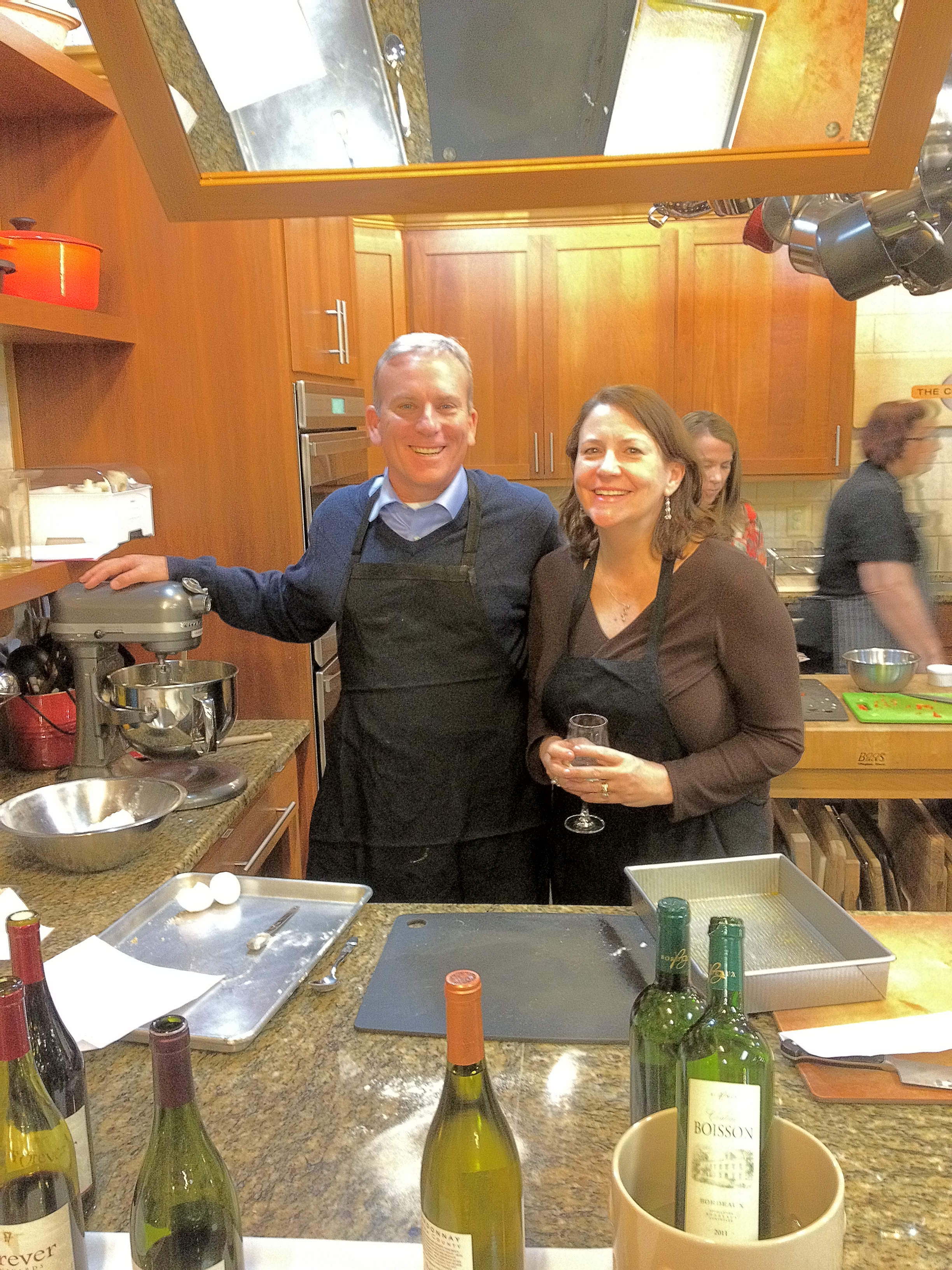
But before I tell you why, a (necessary) backstory. About a week ago, my husband and I were guests at a “hands-on” dinner party: The kind where each couple has gets to help with the cooking. As the evening began, five couples sat at the table drinking wine while Professional Chef Rosemary described the recipes and the process ahead. Each couple would choose a dish to prepare, and with the help of an assistant chef (and pre-measured ingredients), create a contribution to the meal.

Mon mari, being a wonderful cook and très intelligent, listened carefully. When the signal was given, he bolted over to the dessert station, pulling me along with whispered assurances that it would be the easiest dish. He also explained that it had the extra benefit of allowing the two of us time to relax and have another glass of vin while our his creation*  was in the oven.

photo

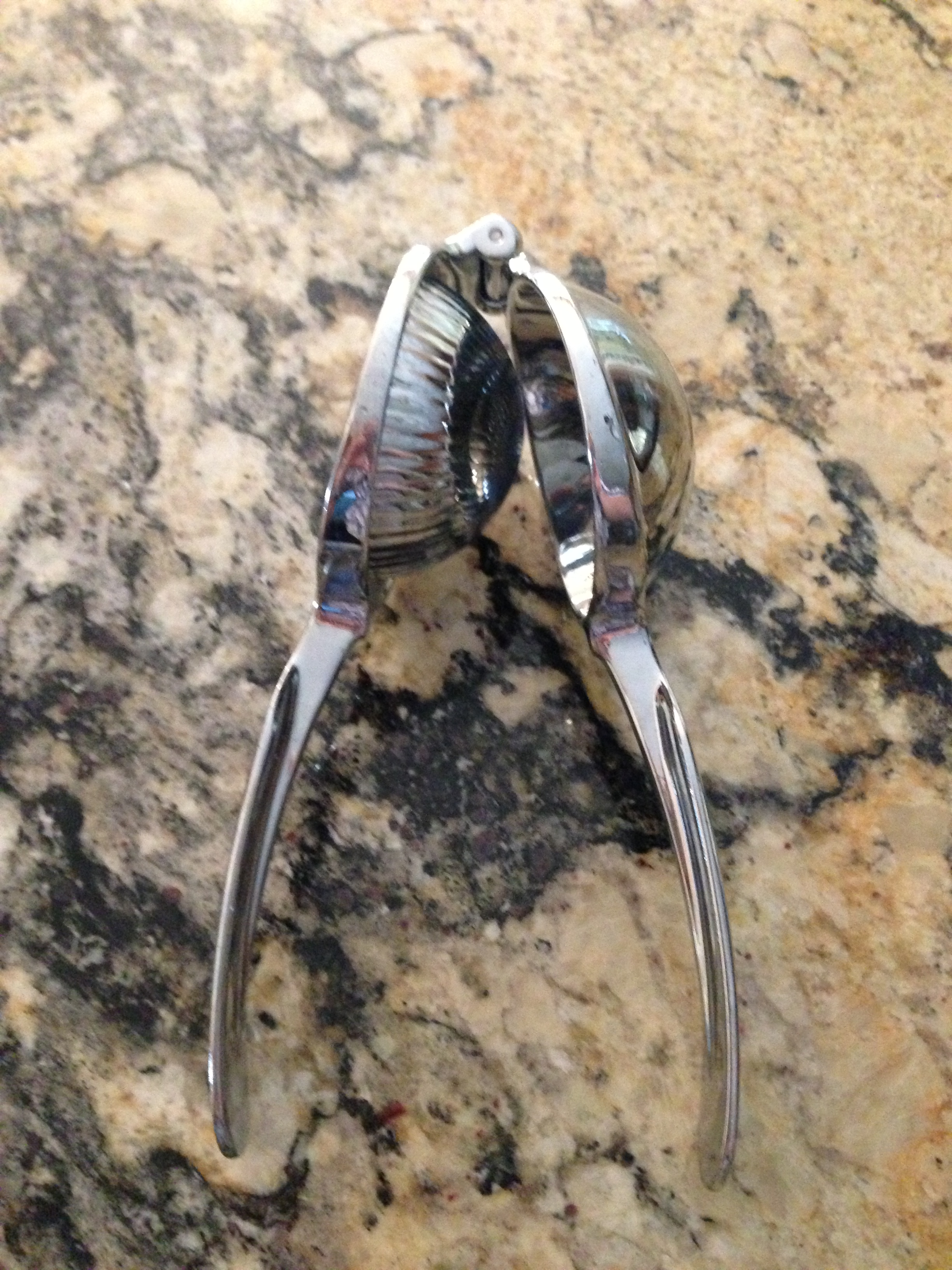
Initially, I helped hovered stressfully around him, and soon our assistant realized it was him that she would be teaching  guiding standing by to watch. As they were discussing the pros and cons of metal versus plastic lemon juicers (she liked plastic), I slipped away. Relieved of duty, I hung out closeby, talking to the other husbands as their wives stirred and sautéed.

photo copy

The metal lemon juicer we have à la maison

We talked a little about football, and then one of the men told the others I was an author and had published a novel. We chatted about my book and then about the one I’m currently working on. When dinner was ready, we all sat down together to a delicious meal.

Afterward, I was asked to speak to the group for a few minutes about writing and answer some questions. One person said he would like to write a book too, and asked me how I overcome writer’s block. I said that if when I come to a point where I can’t continue a project, I work on something else: research, a blog post, marketing MAKE THAT DEUX, or just rereading (and revising) what I’ve written. Then, after a time (hopefully short), I know exactly what comes next in my novel.

Which brings me to football, and my list of ways that it helps me avoid writer’s block:

1. The objective is to advance the ball (or story). Sometimes you don’t get it very far, but if you can just keep making first downs, you’ll get there – and you don’t have to make a first down on every play. But if you give up, or if you’re three-and-out, you’ll have to punt. Not fun.

2. If you’re confused, take a time-out. Then get your head together and come back with a plan.

3. Be open to changing your strategy. Be flexible. What you thought would work may not. If something you’re doing doesn’t help advance the  ball  story, change it. There’s no reason to hold on to a plan that won’t work.

4. You have to work hard, and you can’t let up. You have to work at it, every day (and every play). Well, almost every day. You need some rest days.

5. Be ready to take advantage of opportunities. The unanticipated can happen. When it does, you have to be ready. If you work hard (see #4), you will be.

6. Be patient. Serendipity will find you. Sometimes you get an unexpected break. If you fumble, pick yourself up and keep trying.

7. Never lose sight of the goal. You want to succeed, no matter what is thrown at you (or away from you). Keep working, and it will happen. “Never, never, never give up!”

Go Falcons!

* “Gingerbread with Lemon Curd Cream” – it tasted much better than it sounds!

Books, Movies and Les Misérables

The movie Les Misérables (Les Mis, or “Lay-MIZ”) won ‘Best Comedy or Musical’ at last night’s Golden Globe Awards, a fact which made me très contente.

The ‘Best Drama’ award went to my other favorite movie of 2012: Argo.

I didn’t watch the Golden Globes — I was just too tired after watching the Atlanta Falcons come back to beat the Seattle Seahawks in the last 34 seconds of the NFL playoff game yesterday afternoon, but that’s another post. I love to know who wins the Globes (and the Oscars), but malheureusement, I don’t always hardly ever stay up to watch the award shows; pour moi, seeing the highlights (and the outfits) the next morning suffit.

I’d only seen 2 or 3 of the other films being considered (I just saw Les Mis last week), though I plan to watch most of the rest. Pourquoi? Parce que I LOVE movies, almost as much as I love books.

Les Mis has a special place in my heart and mind for many reasons. One reason, of course, is that the story is adapted from the French novel by Victor Hugo. Another reason is that it’s a musical, an opera really, and the songs are fantastique; I grew up in a household where musicals weren’t admired, so maybe that’s why my rebellious self loves them that much more.

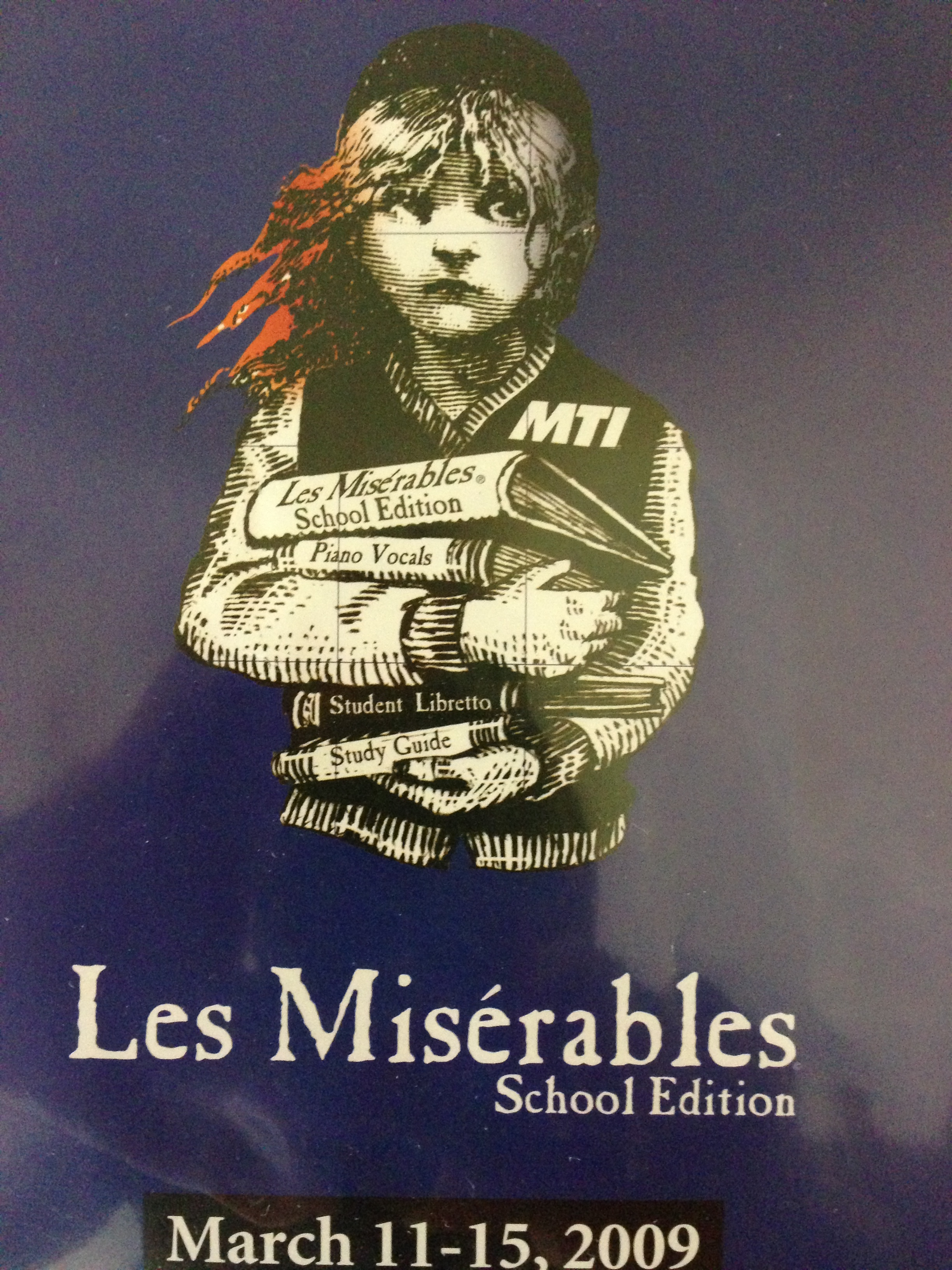
But the third reason I love Les Mis is that one of my sons acted in the play in high school a few years ago, playing the role of the innkeeper Thénardier, and he was amazing, funny, and terrific.

The Playbill

lesmis

This son (who had played basketball, baseball, soccer, football and had run cross country) began acting and singing in high school plays at the age of fifteen. Two years later he joined a wonderful cast to sold-out crowds; the production, now a legend at his school, was marvelous, and standing ovations were standard. It was a high school play, like unlike any other.

I saw the film Argo not long ago, and found it intriguing and fascinating. Based on real events,* it takes place in 1979-1980, the time setting of my new novel MAKE THAT DEUX. I was captivated not just by the story or the actors, but their clothes and hairstyles, since Jenny and her friends in MAKE THAT DEUX were in college during that era.

So it was a bit like seeing the Golden Globe “casual” outfits of my novel.

Which brings me to books. I love them, more than movies, and the best movies are those that are adapted from books: novels, non-fiction, even children’s books.

My favorite children’s books are those written by Dr. Seuss, and I believe one of them was made into a very entertaining movie a few years ago (“A Person’s a Person, no matter how small.”)

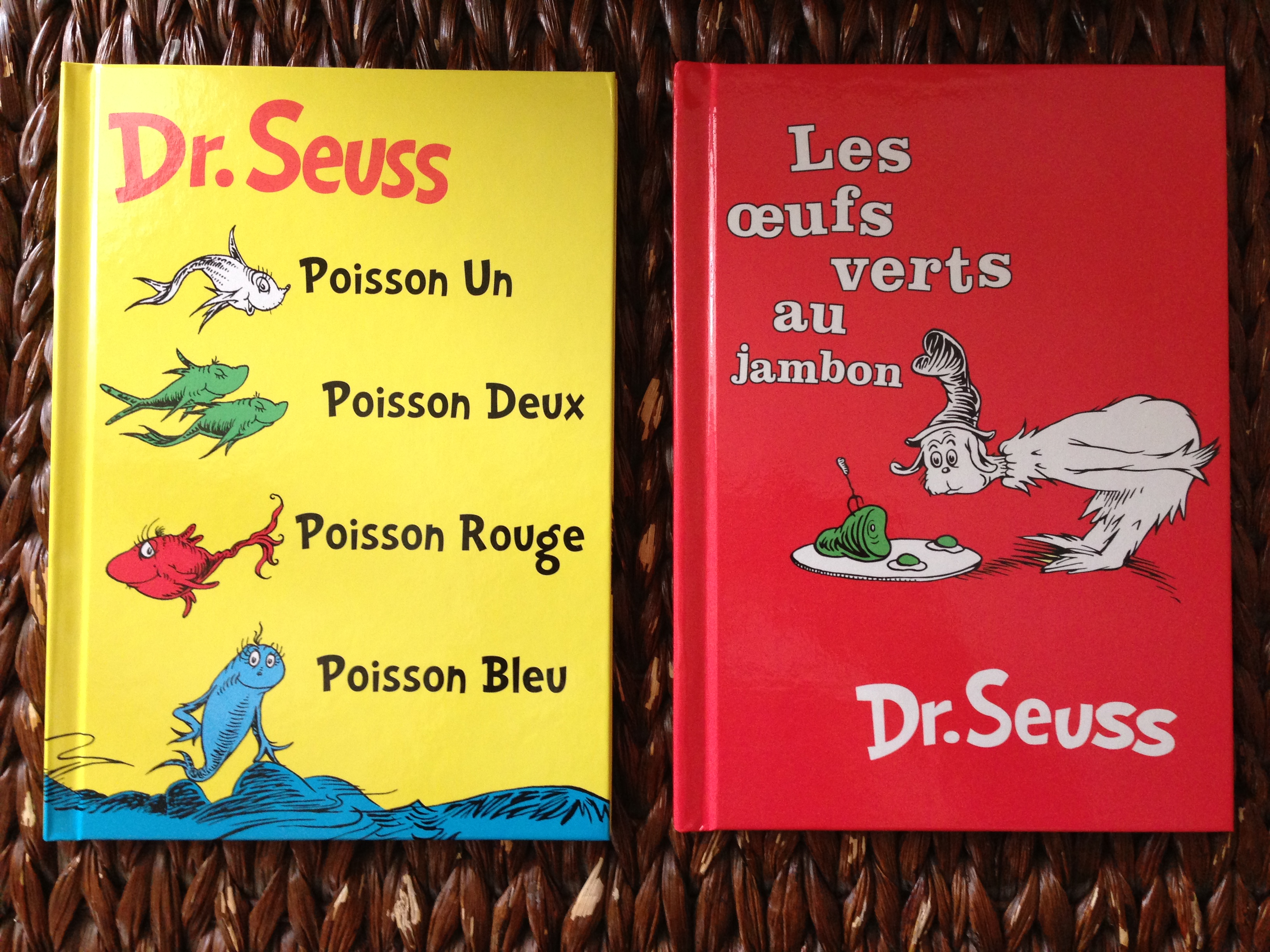
While browsing in a shop today, I came across these 2 Dr. Seuss editions that I just had to purchase (guess why?)

photo

Hmm…if only I’d had these when my kids were little. Then, they would might have learned to speak français as well as English…

* A captivating and compelling book about the Iranian Hostage Crisis of 1979 is Mark Bowden’s Guests of the Ayatollah. I highly recommend it.

From “Unwritten” to Published, with confidence (la confiance)

A few years ago, I told a close friend en toute confiance (confidentially) about my dream of writing a novel and my plan to begin that fall. Rather than looking at me like I was crazy, she was excited for me, and very encouraging.  A short time later, she gave me a song to play for inspiration, a few lines of which I quote:

“I’m just beginning, the pen’s in my hand, ending unplanned. Staring at the blank page before you. Open up the dirty window. Let the sun illuminate the words that you could not find.”

– Natasha Bedingfield, “Unwritten” 

I didn’t have a lot of confidence in myself as a writer, but I believed in my idea. I had a finished outline, and I had the time to work. And I had a passion for my story.

So I sat down and stared at the blank page —  on my computer screen — and began.

I also confided in another friend who knows me well. She said: “Don’t ever let anyone tell you that you can’t do it.” Believing in myself — la confiance en soi — has been always been difficult, no matter what my accomplishments or abilities. I’m usually quick to listen to those who say I can’t, and slow to prove to myself that I can.

But like Jenny, the main character in my recently published novel MAKE THAT DEUX, I like to challenge myself. I wrote the first draft that school year. Later, as I worked on revisions (and on my next novel, a Thriller), I decided to re-learn to speak French.

Even though I had once spoken it fluently, I had just moved to a place where few people spoke French. With lack of use, my French-confidence started to wane. Others’ lack of impression with my ability to speak French translated into my lack of belief in it and myself. As the years passed, I lost much of my ability and knowledge of the language as I got (and stayed) busy, with life.

Malheureusement.

De toute façon — anyway —  over a year ago, I let a French friend know of my wish to study the language, and he recommended a small weekly class. I met with Madame, and soon I was doing devoirs — homework — organized in a binder. I started using French language apps on my iPad. I met and began a friendship with Zeina, my mother’s Lebanese neighbor; because she is so agréable, we speak French when we rendez-vous.

And last summer, when my husband and I spent ten days in France, I tried my French at every opportunity…and I had many.

Le résultat: Though I still (at times) struggle with the simplest phrases, I’ve increased mon vocabulaire considerably. And although I continue to say (even en français) that “I don’t speak it well,” mon prof de français (and Zeina) insist that I do. It’s a question of confidence, not one of ability. But I continue to study, speak, read and learn.

And write.

“Today is where your book begins.” 

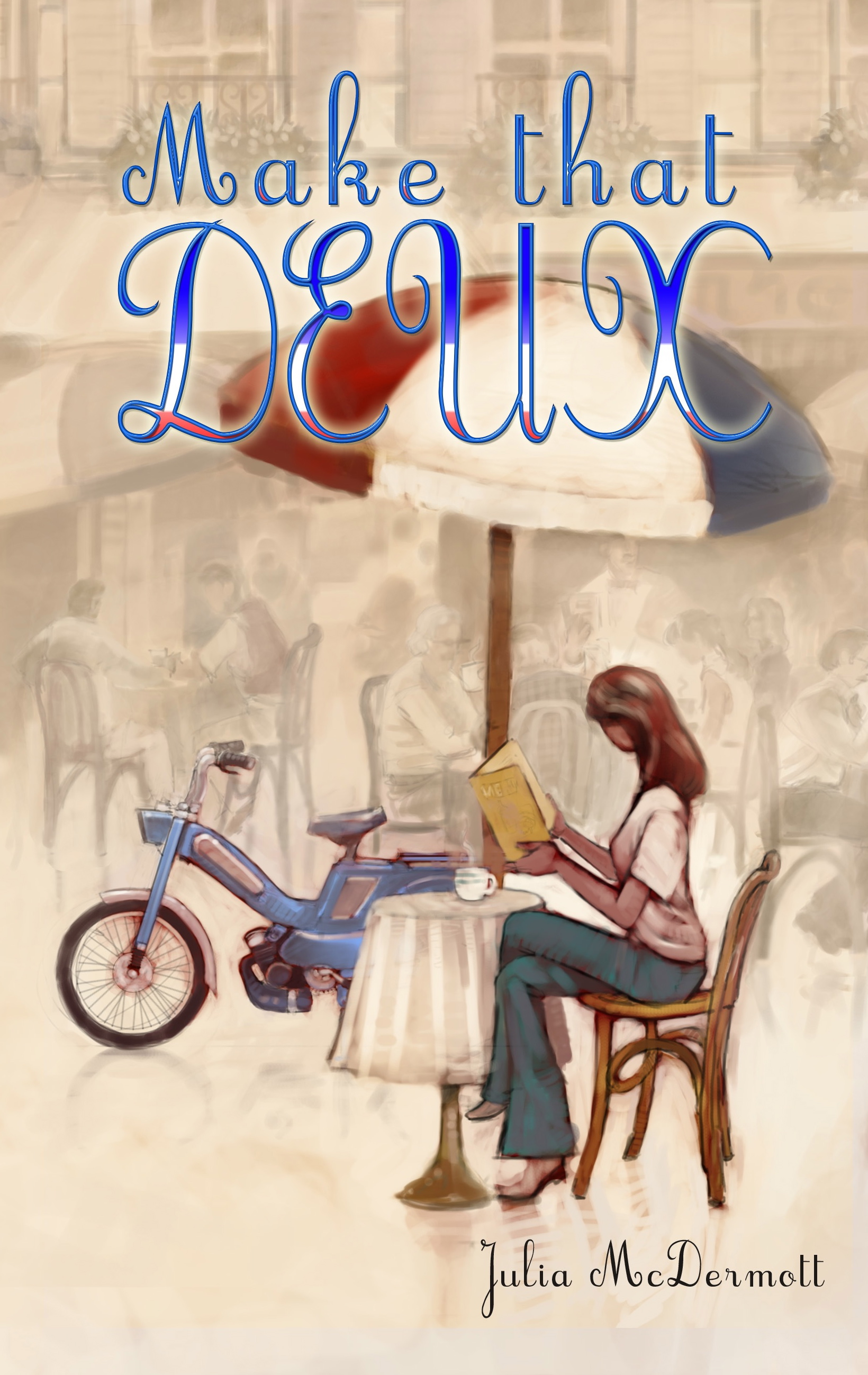
Make that…my book cover! — et son histoire

As promised…

Because the French are very good at mathématiques, here’s the story of the creation of my book cover, in an equation (une équation):

La serendipité L’artiste  *  [l’inspiration + le talent + la technologie]

MY BOOK COVER (La couverture de mon livre!):

Les détails:

Serendipity: Last spring — at long last — I finished the final edit of MAKE THAT DEUX, and began planning its publication. A top item on my to-d0 list was to find a cover artist. Then, just before Easter, my daughter and I visited beautiful Sarasota, Florida for several days during her spring break. “Kim” lives in Sarasota and she invited us to spend one afternoon with her and her husband at their beach cabana.

I told “Kim” about my plans for publication, and she mentioned a friend and cabana-neighbor, writer Peter McKenzie, author of THE PARAGON GANG. “Kim” suggested I look up Peter’s book on Amazon and give him a call. I found the book, downloaded it on my iPad, and called Peter. When I  complimented him on his book cover, he recommended the artist, Michael Faron of Sarasota. Back in Atlanta, I read through Michael’s website www.msfaron.com and sent him an email…

Et voilà! I had found my cover artist.

The Artist: First, Michael read MAKE THAT DEUX. Then we began discussing ideas and sketches that he sent me. We narrowed them down to one… and, aided by inspiration, talent and technology, Michael did the rest!*

As an added bonus, here’s the book description for MAKE THAT DEUX  that you will soon see on Amazon:

Three American college girls living in an apartment on the Mediterranean. Two boyfriends back home. “The One” (and only), if it’s “meant to be” — whatever that means! 
Jenny Miles has three goals: to speak French like a native, to travel all over Europe, and to have a blast. Meanwhile, two men compete for her attention and amour, ici et là. C’est compliqué! 
Take 10 months. Add 2 (surprise) transatlantic flights, 2 Greek isles, 1 moped (une mobylette) and beaucoup de lettres! Subtract 1 phone, 1 promise to be faithful, and 1 bikini top. La solution?  
Make that…a year that Jenny will never forget.

In the cover art that Michael created (and in the book description above), somehow I’m reminded that the more things change, the more they stay the same…

* Including the back cover, which I may reveal in the future…


What would Julia do? Faire la cuisine française

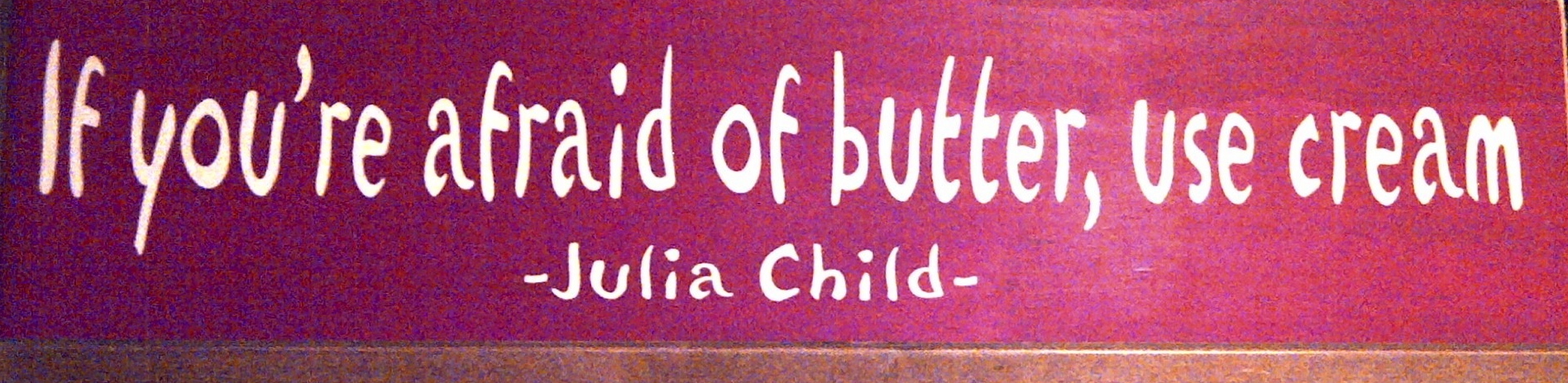
Anyone can cook, with butter.

– Anonymous

My husband and I heard that offhand comment a few years ago at a fête — and a new (ironic) family motto was born.

Because, not anyone (such as, well, me) can cook, even with butter — an ingredient that my husband doesn’t fear.* En fait, because he enjoys faire la cuisine (and since I don’t know how), he does the cooking in our home, toujours — every day — an arrangement that works for us, and one that’s never changed. 

(If he doesn’t feel like cooking, we order a pizza, eat leftovers, or go out.)

As you might imagine, some of our his favorite recipes are found in cookbooks written by Julia Child.

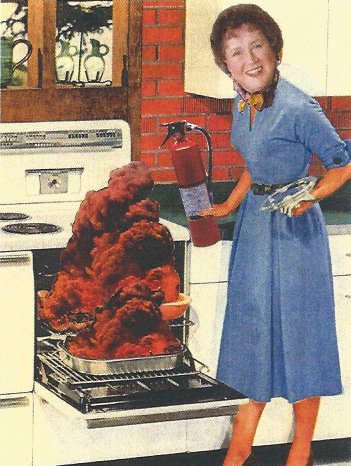
If I were Julia Child

So, whenever he tries a new and complicated recipe (which is often) — if it calls for butter (which is quite often) — someone in our family might remark to him that, well, “anyone” can cook with it.

Then, he laughs…and concocts something délicieux. 

I blame my inability to cook on my family growing up: my father did the cooking, so I thought that was normal. Evidemment, it was one of the qualities I looked for in a husband. That, and a sense of humor, patience, and optimism, among others.

But from what I’ve observed, cooking almost requires those three — at a minimum.

In my soon-to-be-available novel, the main character, Jenny, is a girl in college, and in one of my favorite scenes, her date cooks dinner for the two of them at his apartment. I’m not saying whether butter is involved, but wine is — c’est certain. But c’est la France, so c’est necessaire. The evening is a memorable one, but not because of the food. I won’t describe it further here, except in these words: guitar, bathroom, and (full) disclosure.

Jenny has her own list of qualities that the ideal man should possess, and I’m not sure they match my own. Let’s just say, she’s open to persuasion.

I don’t know what Julia would do. But – what will Jenny do? Il faut acheter le roman! (You have to buy the book!)

*


L’esprit de l’escalier, spiral staircases and faux-amis

As I have asked mon prof Marie-Hélène many times, Qu’est-ce que ça veut dire?

The answer: literally, “wit of the staircase” — I’m picturing a spiral one —  or, a repartee thought of only too late, such as (often, for me) on the way home. Unlike my quick-witted husband, who has a talent for the perfect comebacks and quips, I get caught up in over-thinking and am slow unable to respond, normalement. That is, until the moment has passed, l’individu is gone and verbal victory is impossible. The stairs have already been climbed.

Like my fear of heights, my tendency toward l’esprit de l’escalier has never changed. Naturellement, when I came across l’expression quite by accident (par hasard) — in a tweet — it caught my attention, I duly noted it and added it to mon vocabulaire français.  

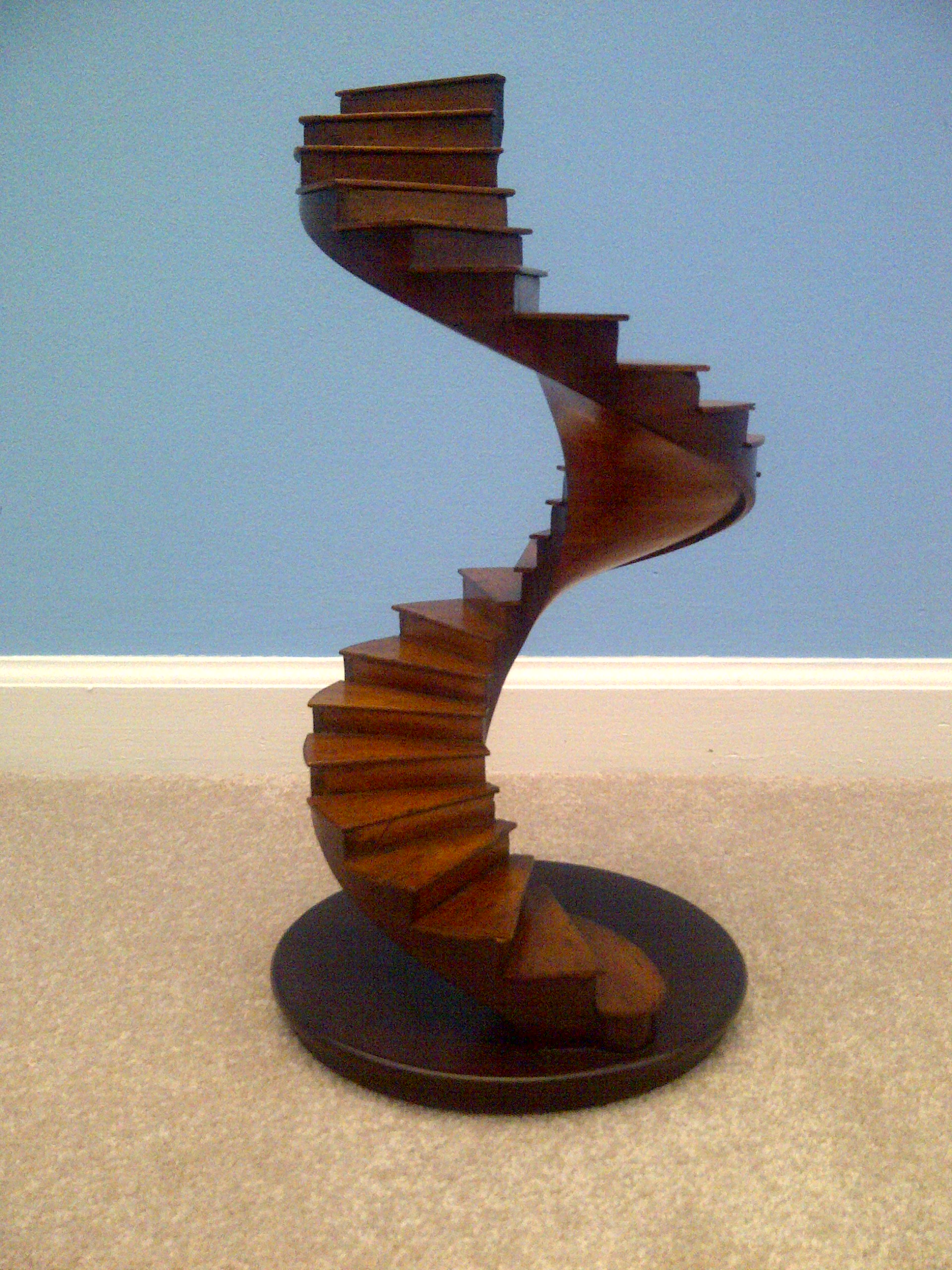
Which brings me to the French term for spiral staircase: escalier en colimaçon, one of my all-time favorite things. In the Parisian home that my husband and I visited this summer, a beautiful wood spiral staircase, slimmer than the miniature one in the above photo, stood in a corner of the living room, le salon. I’ve always wanted a spiral staircase in my house and lobbied to get it when we added on some rooms a few years ago. Alas, the combination of architecture and budget wouldn’t permit it, so I had to settle for a small, decorative one.

Enfin, another recent addition to my French vocabulary, thanks to Marie-Hélène: faux-amis.

Ça veut dire: French and English words that look similar, but have different meanings. Par contre (on the other hand), vrais-amis are words that look similar and do have the same (or similar) meanings. Évidemment,I just used some of the latter, above. Since many words in the two languages have the same roots, it’s not that suprenant (unusual).

Voici some examples of faux-amis that I have learned in class (or en France) and their meanings in French — pour moi, il faut les apprendre:

Car: bus (coach)

Cave: cellar

Confidence: secret

*Distraction: amusement

Figure: face

Grand: tall

Grave: serious

Habit: clothes

Pain: bread

Sensible: sensitive

In my novel, out soon, the main character climbs many an escalier en colimaçon, including a famous one en Italie and a very old one (of course) in Montpellier, France — even though she’s not fond of crumbling ones and also suffers from acrophobia.

But she does know her faux-amis, and her (very witty) amis, aussi.

*This week’s faux-ami 

La Compétition: Bravo!

Les jeux olympiques have changed over time, but la compétition hasn’t.

This year’s summer olympics took place right after my trip to France; as we were leaving Europe, tout le monde was arriving. Watching the olympics on television, I was amazed by the athletes’ physical abilities, their strength, courage and determination — and their sheer competitiveness.

I’m not competitive by nature, though my husband might disagree. In fact, my recurring statement, “If I can’t win, I’m not playing,” has become a sort of household inside joke, since it really means I am competitive.

I want to win — just like all the athletes who competed in London this summer. But I suspect they all believed that they could win in their sport. They wanted to win. Otherwise, why train? Why even compete? Though I exercise, I don’t try to beat others in races or sports. I’m not a big game- or card-player either, but I like to compete in some mental matchups. I’ve gotten very good at Scrabble, for example, thanks to a desire to beat a certain sister-in-law, and no one in my house will even play me in Mastermind (see above quote).

I want my teams to win, too. Since I’m a Tar Heel, I love to watch UNC win at play basketball, especially against arch-rival Duke (though I’ve developed a soft spot in my heart for the Duke Medical Center). I’m also a big UGA Bulldawg fan, and I love the Atlanta Falcons.

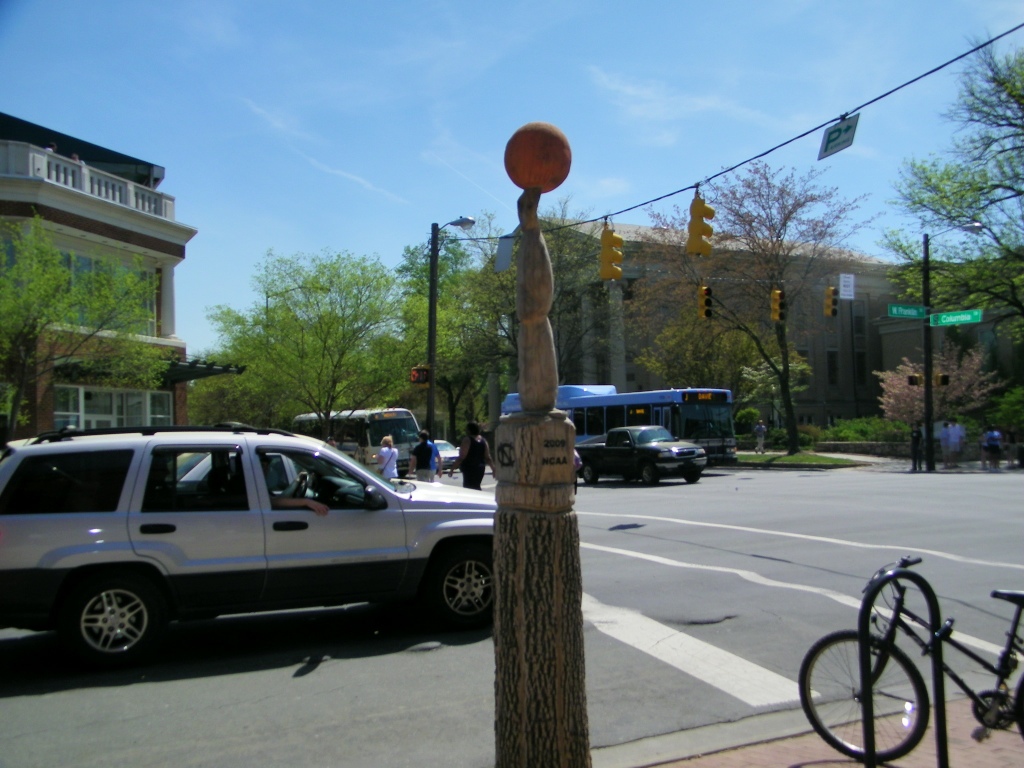
UNC 2009 Basketball Championship sculpture, until recently located in front of Spanky’s restaurant on Franklin Street in Chapel Hill, North Carolina

But back to personal bests and achievements. In this age of social media, I find it a bit troubling weird that so many people post not just those, but all their personal (only good) news, big and small.  Many also share updates about their fabulous trips* as part of a carefully shaped and managed narrative. What are friends and followers to think but “Good for you?” Or, Bravo!

A recent WSJ article by Elizabeth Bernstein titled Are We All Braggarts Now? examined this fairly new phenomenon. Though I’m active on Twitter and (finally) about to create a Facebook page, aside from writerly and the odd motivational (and sometimes cryptic) tweets, I’m endeavoring to keep personal business personal. But that’s just me.*  And, well, marketing is…marketing.

The protagonist of my novel, coming out soon, gets to watch an historic and exciting olympic game, and, though she’s only twenty, reflects on its significance.

But she quickly reverts her attention back to her own life, as any normal twenty-year-old would.

*Oops, I guess I’ve been doing that whole look-at-the-photos-from-my-fab-vacay-in-France thing in recent blog posts. Desolee!

When it’s out there, reader – le jugement


Now that I’m back from les vacances en France, it’s time to travailler – work – again. As the French say, Faire et refaire, c’est toujours travailler. 

The suitcases are unpacked, the clothes washed, the photos sorted, and the memories treasured. Talk of another future visit – someday – is happening, with a slightly different plan, and preferably, not during l’été – the summer. But it was a fabulous trip, a welcome break from routine and a wonderful time to share with the love of my life. We spent a lot of time together, spoke French (well, I did, and he did un peu), and saw sights both famous and little-known, the latter just as impressive.

We started in Nice and ended in Paris, visiting many other villes, villages and a chateau in between. With sporadic access to wi-fi (in French, it rhymes with leafy), we stayed “dark” for the most part – only a little frustrating, and actuellement quite liberating. And neither of us “worked.”

At the end of week one, we traveled to a city in the south, Montpellier, and had lunch at a nearby Mediterranean plage – beach – in a town called Palavas-les-flots. It was a nostalgic stop on our journey – the place where I spent a year as a college student, where my boyfriend (now my husband) sent me letters and flowers. Visiting it with him after so many years together was indescribably romantic. Since my novel takes place there in an earlier time, our voyage to Montpellier and Palavas doubled as research; when we got home, I did a final fact-check review of the story and tweaked just a few lines, as necessary. But even though much has changed there since 1979, much is also the same.

Now, chez nous, it’s time to blog again, tweet and work on my next book, as I prepare au meme temps to release the first. Which brings me to the subject of today’s post: the fact that once “it’s out there,” my novel will no longer really be my own. It will belong to the reader, who will judge it and its characters. Much of the story is based on true events, but much is not. Memories from my time in France long ago are imprecise in some ways, but clear in others. But it’s not the specifics or any incongruities that worry me.

It’s le jugement.

Because even though it’s popular to claim that we don’t judge – and even say, “don’t judge me,” in truth, we do make judgments all the time. We form opinions and justify our positions. When we read fiction, I think we almost feel we own it; we decide what’s good, bad and neutral; we judge the plot, the writing and the ending. All of this is fine and well, and it’s what we as authors know as we write.

But now when I read someone else’s work, I read not so much as a reader but as another writer. I think about what led the author to write the book. I think about the travaille, the brainstorming and the planning, the edits and revisions. I think about the author choosing the title. Having grown as a writer, I’ve changed as a reader. When my book is “out there,” of course I hope that judgments are good and reviews, positive.

A bientôt.

[Note: above photo is of The Conciergerie in Paris: once a palace, it was converted into a prison during the Revolution and became a symbol of terror. This was where Marie Antionette was imprisoned  before her execution.]

Bonne Chance

As I searched for inspiration for today’s post, out of the blue, my husband (who believes in serendipity) forwarded WSJ article You Call That Lucky? Actually, Yes by author Anne Kreamer.

Kreamer writes that, although she’s been reluctant in the past to attribute successes to luck  (“circumstances beyond my control”), she recently reexamined the idea: perhaps luck played a part. Looking back at her professional journey, she describes “lucky moments” that presented themselves, and when opportunity knocked, she was prepared: she had worked hard. Her conclusion: Reasonable success = [good] luck + preparedness.

But we all know that luck isn’t always good. Kreamer provides an example of a situation that “looked like” bad luck, but wasn’t: it led to a better position and good fortune.

I believe in fate, in serendipity — in luck, whether good or bad — but I prefer the French word, chance. Why is it that, when circumstances beyond our control lend themselves to aid us in achieving our goals, we don’t want to call it (good) luck, but choose instead to claim all the credit? And why, when different, uncontrollable circumstances lead to the opposite, we’re so inclined to blame bad luck rather than ourselves?

I’ve had some professional and personal good luck, but I’ve also had my share of the opposite. But as I dealt with those unfavorable, unfortunate events in the past, I did the best I could. I survived. I worked, as Kreamer says one must, believing that my luck would change. When my husband and I faced a financial crisis in our twenties, we felt alone and snake-bitten. Blaming bad luck (at least, partially) then, rather than ourselves, or worse, each other, helped us get through it. But we also took responsibility for our situation and came together as a couple, learning from our mistakes.

Since then, we’ve faced many other challenges and trials professionally and personally. Just in the last few years, we’ve lost both our fathers and have watched our youngest son survive brain cancer. But my husband and I have also had a lot of (good) luck, and sometimes the difficulties we have faced together have turned into blessings. We’ve stayed together long enough — thirty years, today — to see a lot of things change. Luck can change, fortunately.

If you just give it a chance, and work hard.

Create a website or blog at WordPress.com

Up ↑