My turn on “The Writing Process” Blog Tour

This post is part of a blog tour on the writing process. Thanks to Kathryn Gray-White, a fellow Atlanta author for tagging me to take my turn.

I met Kathryn at a combined book signing event that we participated in last month called “Books in the Garden” at Specialty Ornamentals in Watkinsville, Georgia; the other authors were Rona Simmons, Valerie Connors and Linda Hughes. Kathryn was signing her book, ATLANTA’S REAL WOMEN, and we chatted with each other and with readers who came to the event. We finished the day with a one hour appearance at Avid Bookshop in nearby Athens.  Prior to meeting Kathryn, we connected on Linkedin. She is a historian and an assistant professor at Georgia Gwinnett College.

MY WRITING PROCESS….

What am I working on?

I’ve just started writing my fourth book (and third novel), a Suspense/Thriller so far unnamed. Book 4 borrows a few minor characters from my novel of the same genre, Underwater, and it turns one of them into a major character. Underwater is the story of a successful businesswoman whose brother guilts her into funding a luxury home just before the housing market drops, plunging the family into a downward spiral of deceit and violence. Book 4 is about another family in conflict over a house, this time a two million dollar beach home that three siblings will inherit upon the death of their wealthy stepmother.

When her sizable liquid assets are stolen by a crooked investor, the stepmother considers selling the beach home to fund her lifestyle in a luxury retirement community. Two of the siblings suggest that she obtain a reverse mortgage on it instead, to keep it in the family and protect their inheritance. But the middle child is secretly grappling with huge debts and unwilling to downsize or compromise. When an unforeseen event occurs, her income drops drastically and her demands multiply. Soon, her hostility toward the woman who took her mother’s place decades ago turns from anger to hatred. How far will she go to get her way, and to get her hands on the money she believes is rightfully hers?

While writing Book 4, I’m also working with my freelance editor, Laura Ownbey, to revise and prepare my third book for release. A work of creative nonfiction titled All the Above, it chronicles my nineteen-year-old son’s battle with brain cancer.

In addition, I’m working with my editor and team at Thomas & Mercer, an imprint of Amazon Publishing, who recently picked up Underwater for re-release this fall.

How does my work differ from others of its genre?

My first book, a French Travel/Romance novel titled Make That Deux, is a semi-autobiographical tale based on my year as a junior exchange student in the late 1970s. So many books are set in France, but I could find none quite like mine, which also falls into the new New Adult genre, where the protagonist is in college, not high school like in Young Adult (YA). All the Above is a personal account of my emotional struggle when the unthinkable happened to my son. Underwater and Book 4 are about adult family members caught up in conflicts over money; the stories pose questions about generosity, enabling, guilt, and duty. Tension builds to a boiling point, and then…

Why do I write what I do?

I write what I like to read, and I like to read a variety (the only types of fiction I dislike are Fantasy, Science Fiction, and anything Paranormal). We expose what we value by how we spend our time and our money, and I’m drawn to fiction about families in conflict over the latter, with fragile relationships to complicate matters. I enjoy writing from different characters’ perspectives because I like showing that individuals can have goals, feelings and personalities that clash. It’s interesting to look at how family members can view the same events and issues in vastly different ways, and can have opposing memories, desires and fears – and keep them secret from each other.

How does your writing process work?

My writing process has evolved over time, and I’m constantly open to learning. I write full-time and have a routine, but one in which flexibility is important; you’ll sometimes find me writing during slow weekend afternoons and up at 3 a.m. when an idea won’t go away. Normally, though, I write for four to five hours on weekday mornings, then two or three more in the afternoons.*

I pay close attention to pacing, and I start with notes, a plot outline and characters that I can get my head around. I ask myself what I’m trying to say in the story and figure out how my characters will show it. I massage my notes as I go and decide when to end chapters based on intuition. I keep track of multiple POVs in a separate place and continually ask myself (and answer) who should speak next in the story.

My writers’ critique group, an offshoot of the Atlanta Writers Club, provides feedback and gives me suggestions and encouragement. I learn a lot from listening to others read their work. I shoot for writing 5000 words or more a week. I write, cut, revise, write, cut, revise…etc. Eventually, the book gets written, and then my editor does her thing. Then, I break down her edit and work on revising once again. After a copy/line edit, it’s finished, and I start on my next project!

I hope you’ve enjoyed this entry in The Writing Process Blog Tour.  Please don’t hesitate to contact me with questions, follow this blog, or connect with me on Twitter (@MakeThatJulie), and Like me on Facebook (JuliaC.mcdermott).


*That’s what I aim for, and what I do, most of the time..Of course, I also take breaks, and get up to do lots of household chores, and exercise!
New publishing contract for UNDERWATER!

A lot has happened since April 7, 2014.

One evening, about a week after my blog post titled Playing to Win – quoting Seahawks QB Russell Wilson, who led his team to win Super Bowl XLVIII (“Why not you, Russ?”) – I received a Facebook message from Anh Schluep, Senior Acquisitions Editor at Amazon Publishing in Seattle. She had read UNDERWATER and enjoyed it: “What a thrill ride!”

She wanted to talk about acquiring it for the Amazon imprint Thomas & Mercer (which publishes Mystery, Thriller and Suspense) and putting their forces to work to give it “the chance to reach more readers.”

This happened right before my husband and I were scheduled to fly to Austin, Texas to attend a nephew’s wedding, then to Napa Valley for the week. I love getting Facebook messages, and this was a very intriguing one. So, I spent half the night awake doing research, responded to Anh (pronounced “On”) the next morning, and we scheduled a conference call for the day before my travels began.

Then, in football terms, it was time for me to revisit the Playbook.

Three weeks later, after a lot of discussion with Amazon, my lawyer’s counsel, and some great California wine, the contract has been signed. Tentative release date for the new edition of UNDERWATER with Thomas & Mercer is November 2014!

Now, I don’t know if Anh (or anyone at Amazon Publishing) is a fan of Russell Wilson, or if they read my April 7 post, but serendipity comes to mind.

“Why not you, Russ Julie?”


Playing to win

“I remember my dad asking me one time, and it’s something that has always stuck with me: ‘Why not you, Russ?’ You know, why not me? Why not me in the Super Bowl? So in speaking to our football team earlier in the year, I said, ‘Why not us? Why can’t we be there?'”
 
– 2014 Super Bowl Champion QB Russell Wilson of the Seattle Seahawks
 

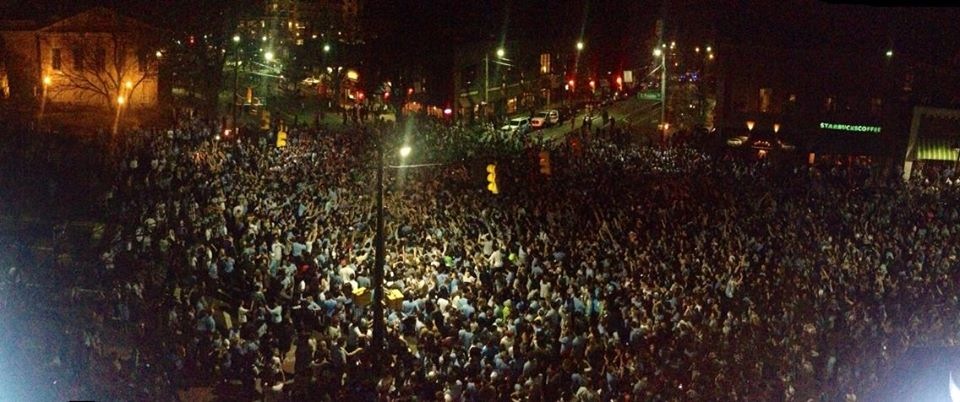
Football has been over for weeks, and college basketball – March Madness – ends tonight. The Tar Heels didn’t make it past the Third Round, but after a phenomenal regular season victory against rival Duke in UNC’s Dean Dome, it almost didn’t matter…especially since Duke was eliminated in the Second Round.

photo 2

UNC students in downtown Chapel Hill, celebrating the victory over Duke on February 20, 2014

[Other than wanting UNC to beat them in basketball, I’m fine with Duke; the book I’ve been writing for almost a year now is partially set in Durham.]

Over the last several months (the coldest October through March in over a century, I read), I’ve been busy writing it, and I hope to finish it soon. The hardest part was the middle, which I was working on during the NFL playoffs (and while Atlanta got zapped with at least three bouts of freezing temperatures and/or snow and ice).

Lately though, I’ve been on kind of a writing roll, and I’m nearing the end. But it won’t be done then; working with my editor (and doing revisions) is next. There’s a lot more to do, too, the most fun of which will be to select a cover. Meanwhile, I’ve got the conflicts and characters identified for Book 4 (a suspense novel) and I can’t wait to get started on it.

So – what does any of that have to do with football, or with Seahawks quarterback Russell Wilson?

In a word: inspiration.

Autrefois, I didn’t like or even understand football. Now, I miss it a ton, and I can’t wait to watch the Falcons play this fall. I watched this year’s Super Bowl, enjoyed the game – and was inspired by the story (and words) of the Seattle quarterback.

Here’s someone who’s worked hard, who might have been considered an underdog, but who didn’t take No for an answer. I’m taking a cue from his words. Why not me?

Why not write fiction (and creative non-fiction)? Why not work full time on my books? Why not be committed to learn, and keep trying to improve my writing? Why not produce the best stories I can, and tell others about them?

Why not go for it?

“Why not you, Russ?”


Character vs. plot: comme vous voulez

“Before I began writing my suspense novel UNDERWATER, I knew the basic plot and the conflict that my characters would face (I didn’t know how to start without it). I had identified the plot points and story arc, though I also had “unplanned complications” along the way. When I began writing the story, though, I started with my characters. I had to know them well (especially the heroine and the villain), so that I could describe their behavior and write their dialogue – so that I knew how they would engage.

However…I realized that another character needed to be different from what I originally planned…I made some changes, and she became more vital to the story, and a stronger, much more interesting character. Problem solved!”

– a Comment I made on writer Deanna Raybourn’s blog post of March 13, 2014. (I met her earlier this month at the Dahlonega Literary Festival when we were both a panelists discussing suspense in fiction.)

IMG_0145About half the panel: Deanna’s on the far right, wearing a reddish-pink scarf, and I’m wearing gray.

The question was about plot versus character, and Deanna and I responded to it differently. For her, it was all about plot – she starts with that, then thinks up and creates her characters. For me – and for the other panelists – characters came first.

We all agreed that either way works – it’s all about writing a compelling story, no matter what your approach. But I didn’t fully understand Deanna’s (or realize how much it and my own have in common) until I read her blog post.

The character that I had to change in UNDERWATER – who became more vital to the story – was someone who developed as I wrote the book. I realized that her personality, her backstory, even her demons were integral to the plot. I knew she would play an important role, but originally, I didn’t know how important.

Hopefully, neither does the reader.

In any case, for me it’s important to imaginer les personnages – imagine the characters – before crafting a story’s plot. That doesn’t mean I don’t have the plot in my head, or even on paper on a computer file (I prefer a blank screen over a clean sheet of paper; typing flows better for me than handwriting).

La réponse to the question? Comme vous voulez – as you wish. Either can work, but flexibility seems key. That way, you’re open to “unplanned complications” (and other elements) that can solve pose problems!

Vive la différence!

Suspense, from a worrier

As I declared to the audience at a panel on Suspense during last weekend’s Dahlonega Literary Festival, I’m a worrier by nature.

Just before the panel discussion:
“On the Edge of Our Seats: The Element of Suspense in Fiction” 
I’m wearing gray, seated between two gentlemen authors.
IMG_0144

The panel took place on Saturday at 4:00. All day, I had greeted and met readers who stopped by my table to ask about and buy my suspense novel, UNDERWATER. I’d also met many of the other authors. It was a beautiful day in Dahlonega, which only added to the cheerful mood of just about everyone.

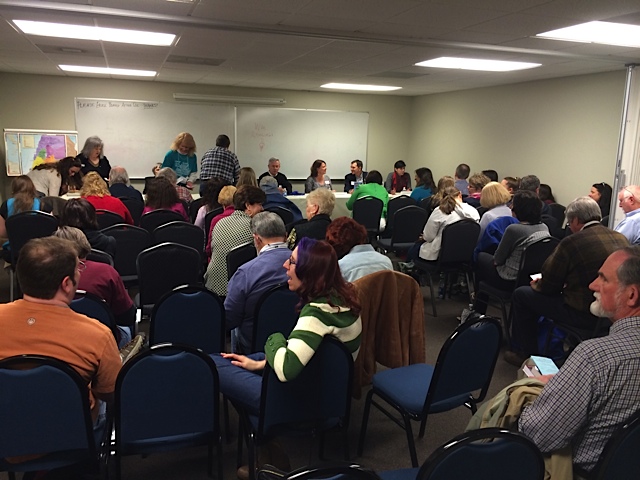
The panel’s format was different from what I’d expected. I had imagined that (primarily) audience members would ask questions (“this question is for so-and-so author:” etc.). Instead, the moderator asked almost all of the (very good) questions, and each of us seven panelists then had the opportunity to respond. I hadn’t been able to attend any of the day’s earlier panels (if I had, I’d have known about the format). Néanmoins – nevertheless – I wasn’t too disconcerted.

First, we introduced ourselves individually. Then the moderator posed a question and asked the person on one end of the table to start the responses. Though each of us had authored a book(s) containing the element of suspense, our works represented a variety of genres, none overlapping (much), so we had different perspectives, and styles. No one’s book was similar to my novel, and I was excited to have the chance to talk about it.

As I said during one of my responses, since I’m a worrier, writing suspense seems natural. I pay careful attention to pacing. I start with the characters and the issues they face (the conflict). As I write, I strive to keep the reader on the edge of his/her seat, worrying about what will happen next. I plan for the tension to rise as the story unfolds, as things go from bad to worse. I want the reader to be a worrier about my characters. 

It takes some work, and I worry about focus on it. But if you’re a worrier by nature, it’s really not that complicated.

From Typing to Skyping…

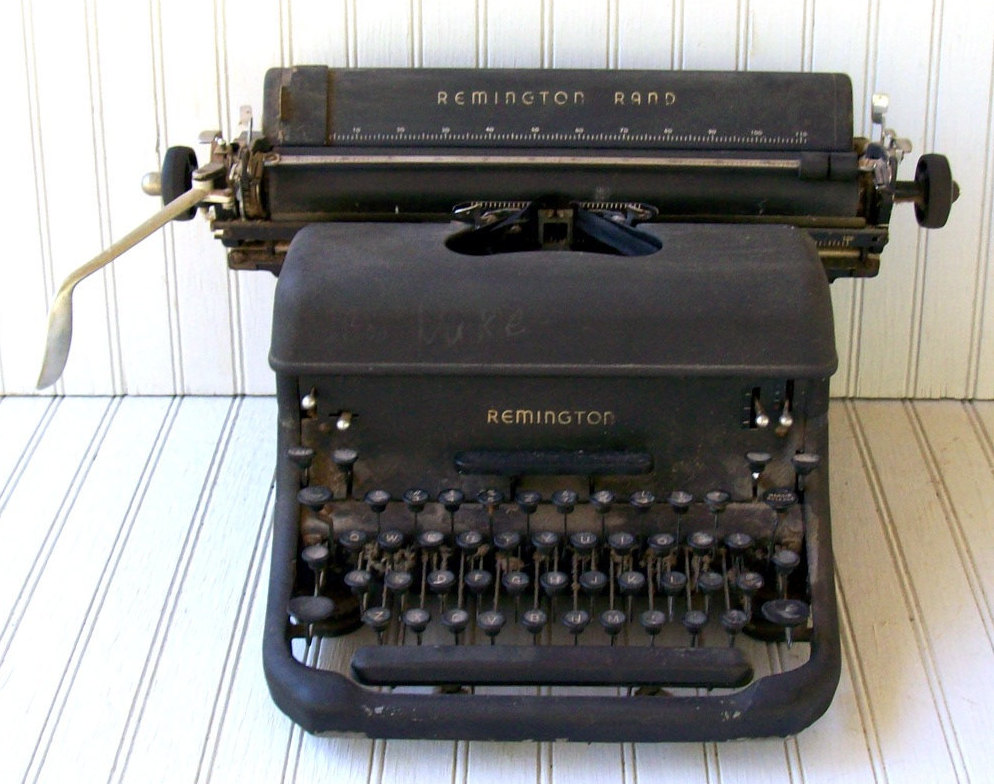
Last summer, I went to a local antiques store with my daughter. She saw an old typewriter for sale and walked over to it.  A piece of paper had been inserted, and she tapped one of the keys.

“It doesn’t work,” she said. I walked over and typed my name on the paper. “You have to hit the keys,” I told her. “You don’t just touch or tap lightly!”

il_fullxfull.370660531_tuyf

  I took typing in high school for one quarter, and learned to type at a decent (but not very fast) rate. Mistakes counted against your grade, and I let speed suffer in my effort to avoid typos. In college, I remember having to carefully retype entire papers (before Liquid Paper came out).

Luckily, my French professors didn’t require typewritten papers – with so many accents, it was nearly impossible. So they had us turn in handwritten papers.  A bit less of a hassle…but still.

How things have changed! Liquid Paper was a blessing in my first job at a downtown Dallas bank. Though I wasn’t a secretary, I typed a memo or two…

Liquid_paper

Fast forward to today. Though we still “type” on computer keyboards, things are different now. Communication has evolved. Writing business (and personal) letters is done via email and social media messages. People read books on their phones and tablets. To sum up a recent blog post by writer J.A. Konrath, ebooks are here, and there’s no turning back.

And people visit with each other on Skype.

That’s how I appeared at a Book Club meeting last night that had chosen to read my suspense novel UNDERWATER.* My contact there – far from my home – had invited me to Skype with the group to discuss the book and my writing. I was thrilled to have the opportunity, to meet such a great group of readers, and to answer their questions over a glass of wine.

Unknown-1

Before our scheduled call, I set up my iPad to Skype in my home office and wanted to test it. But now I was the one saying to my daughter, “It doesn’t work!”

I texted her at her North Carolina university, and a few minutes later she had downloaded the app on her laptop. Then she called my Skype name…

photo 4 copy

photo 41 copy

Between “So pick up” and “Just finished and it went great!” (over 3 hours later), she helped me make sure my device was ready and that I was happy with how I looked onscreen.

She’s minoring in French, and sometimes (though rarement), that’s how we communicate.

Merci, ma fille! Tout s’est bien passé!

* If your Book Club chooses UNDERWATER and would like me to appear at your meeting via Skype, please let me know! 

Getting yesterday back

Yesterday’s gone on down the river and you can’t get it back.
– Larry McMurtry, Lonesome Dove
 

As a writer of fiction, I draw from my own experiences. But I also tell stories that I make up, out of my imagination. I don’t tell a story the way it happened, but the way I thought it should have. *

So “yesterday” is a good place to look for ideas, even though in life, you can’t get yesterday back.

Lots of things that happen in my novel MAKE THAT DEUX really happened (or a version of them did), but lots of other things didn’t. I did spend a year in France when I was young, and I missed my boyfriend back home. When I wrote the novel, I got to tell the ending of our story, not as it really happened, but as I wished it had.

My latest novel, UNDERWATER, isn’t based on an experience. But some of the characters’ internal conflicts are drawn from my own struggles. The water “down the river” isn’t always calm. Even if it looks okay, in my characters’ lives, there’s a lot lurking below the surface: Guilt. Lies. Jealousy. Hurt. Bitterness. Regret.

The tension builds, and as an author of suspense, I know that

worry = suspense.

As I wrote UNDERWATER, I knew that its “yesterday” had to be problematic at best. I wanted to keep you, the reader, worried about what was going to happen next.

And since by nature, I’m a worrier, I just had to let the river flow.

* to paraphrase Betty Smith, author of A Tree Grows in Brooklyn: “A story was something you made up out of something that might have happened. Only you didn’t tell it like it was, you told it like you thought it should have been.”


The Road Not Taken: Part Two

According to Alison Wolf, author of The XX Factor: How the Rise of Working Women Has Created a Far Less Equal World, as a “graduate mother of four,” I’m an “extraordinarily rare beast.”

Not surprisingly, it’s a label that caught my eye. Having earned an undergraduate degree in economics, then taking several courses towards an MBA (the pursuit of which was halted, once I gave birth to twins), I’m not sure if I qualify in Wolf’s view as a “graduate” mom.

(But even if I don’t, I’ll say I do.)

For my first year of motherhood, I went back to a job I truly enjoyed and for which I was adequately (if not yet extremely well) compensated. It was the 1980s and the industry was IT: I worked for a software developer in Richardson, Texas. Day care was difficult to find (and hard to accept, after I visited the place). My solution: a nanny who arrived at my house at 8 am and left at 6.

Problem solved – for a while. I focused all my energy on my work, both in the office and at home. Of course, my husband helped; with two babies, he had to. But when he was offered a much better-paying position in a different state, I made a decision that Wolf says is rare for women with my educational background.

I took the road less traveled: I became a stay-at-home mom.

23450

Even with my husband’s new job, it meant downsizing; as we simultaneously dealt with a home that was “underwater,” our stress increased. Not everyone understood our decisions, but we came up with a financial game plan (à la Dave Ramsey), and over time, it all worked out. We learned to live on one income – also something rare, according to Wolf – but something that “made all the difference.” *

That income increased over time, and so did our financial stability. We’d always wanted four kids, and our wish came true: when our twin boys were five, their brother was born; three years later, our daughter arrived. [I’ve read that “three is the new two” – as far as the “right” number of kids to have – but for me, baby #4 turned a crowd into a party.** And, well, I like parties.]

Now, our daughter is in college; “the boys” are all in their twenties. The road I took – raising kids (and managing/running a household, with no “outside” help ***) – has ended, and I’ve launched a new career as a writer. Abandoning my professional track years ago had its consequences (many of them described by Wolf), but it’s also had its benefits: more time with my family, [perhaps] less stress, and a happy marriage.

[I’m not saying my marriage wouldn’t be happy, had I kept working outside the home; I’m just saying I didn’t, and it is.]

As for being “an extraordinarily rare beast” – well, I find that to be a little pejorative, even judgy. I never engaged in “The Mommy Wars,” other than to defend my decision to stay home. Wolf refutes a New York Times article’s reference to a group of Atlanta mothers (that I don’t know, but who resemble lots of my friends) as representing an”exodus of professional women from the workplace;” she claims it’s statistically insignificant. Really?

Some (but not the vast majority) of my other friends and relatives, with various levels of education and compensation, continued in their careers when they became moms, without missing a beat, or much of one.

They chose to take the other road.

My jury’s out on Wolf’s latest book. My mother kept working because she felt she had to (while her mother provided free child care), and my daughter just began her university education. [Due to the rise of working women], is the world really far less “equal” for her than it was for me, and for my mom? Must all educated professional women be “like” educated professional men? Are there no other acceptable options? And is there only one route to a “successful” life – no exit or entrance ramps available?

If so, de mon côté, I’m still glad I took the road less traveled.

* The last four words of  The Road Not Taken by Robert Frost
** “Two’s company, three’s a crowd, and four’s a party.”
*** I did have “inside” help: my husband has always done the cooking.

“Time Travel:” mon expérience

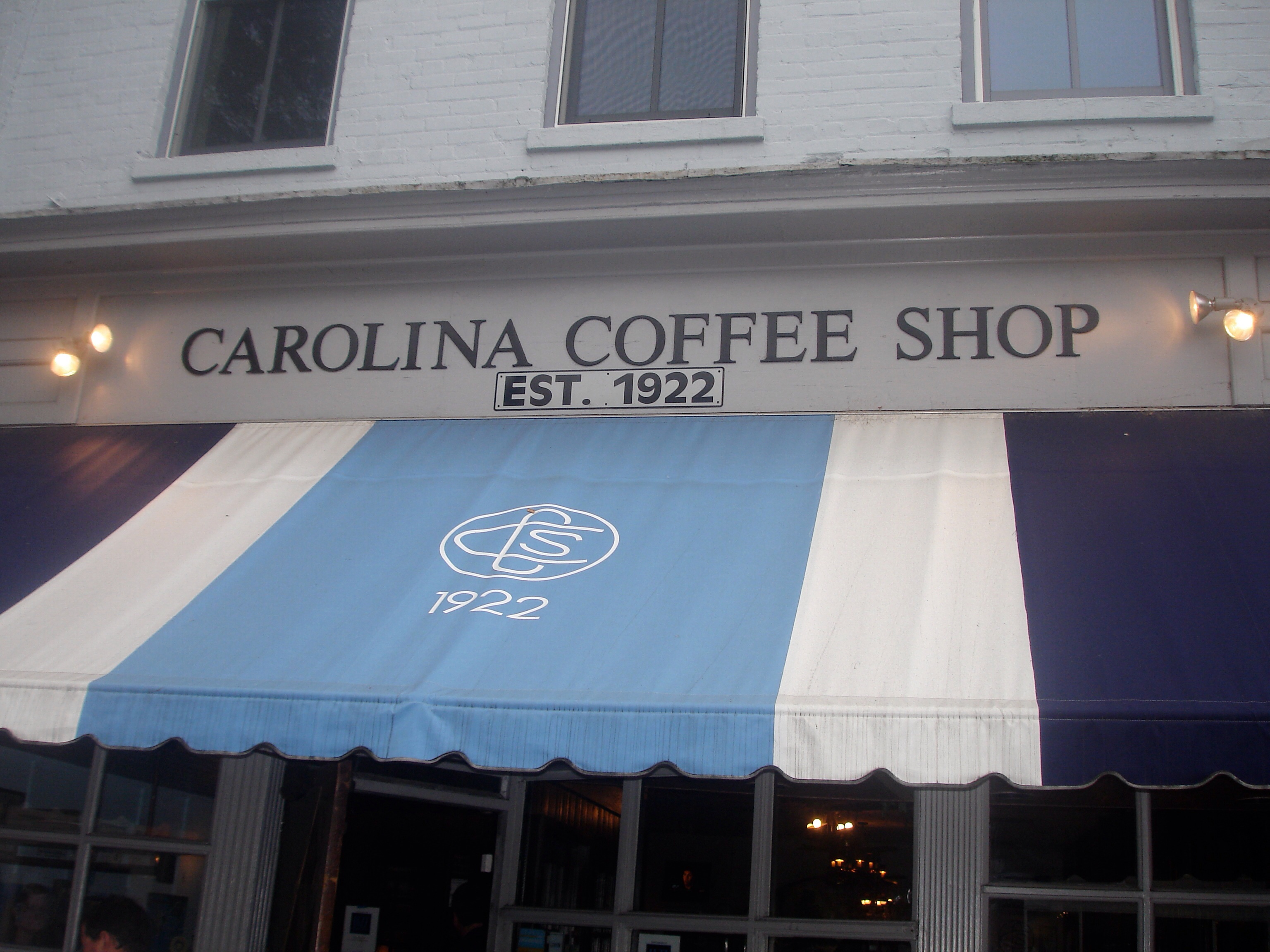
L’interview took place last August at the Carolina Coffee Shop in Chapel Hill, NC, right before UNDERWATER was released.I had just dropped off my daughter at college and was planning a Launch Party for my new Suspense novel. The interviewer was fellow Tar Heel Lucy Hood, who had studied in Spain just a few years after I returned from my year abroad in Montpellier, France on the UNC program there.

image

Fast forward to January 2014, and you have Lucy’s article, Time Travel, in the current edition of the Carolina Alumni Review!

You’ll find a lot about my first novel MAKE THAT DEUX, which Lucy and I discussed that morning, a little about UNDERWATER, and a few things about me (including a recent photo).

While MAKE THAT DEUX takes you back to the 70s (think: American Hustle, Argo and the Bee Gees), UNDERWATER is set in current times. It takes place in Atlanta and New York, with a scene or two in France.

I’m not a big “time travel” person when it comes to the movies, when that means the characters can go back and forth in time and try to alter or fix things that happened, then deal with the ramifications. But one movie that does it well, in my opinion, is the not-so-famous film that came out in 2000, called The Family Man starring Nicolas Cage.

In the movie, there was a boyfriend and a girlfriend, and one of them was going to spend time in Europe for a great opportunity, and then they…

Well, it’s a romantic, sweet story, just like (but different from) MAKE THAT DEUX. But if you want to take a different journey, filled with conflict, betrayal, despair and deceit, go deeper and dive into UNDERWATER.

You may have a hard time coming up for air.

My Christmas Poem, y’all

“I want to know everything about you, so I tell you everything about myself.”

– Amy Hempel

Until I realized that almost no one read it (see recent WSJ article Bring on the Holiday Letters), I used to write and send out a Christmas poem every year, and I (rather) miss* doing it.

So, inspired by the Journal author’s words that holiday letters (for me, poems) have a of “seasonal warmth,” and her reminders that they

“…bring us together in a way that our relentless digital connections cannot…represent tradition in a world that discards traditions too quickly…and they require real effort and thought: Somebody took the time to write them.” (emphasis mine)

…here’s my latest:

The kids are all grown; the house, empty, almost –
No more lunches to make, no more bagels to toast.
They’re all doing their thing; my job raising them’s done –
And for me and my husband, the fun’s just begun.
 
Around les enfants, my world used to revolve.
When ma fille was twelve, I found a nouvelle resolve:
I sat down to write books, and I ceased to write verse
For my “holiday letter” – of it, I would disperse.
 
“Who would miss it?” I thought. Just a relative**  few.
All the others would not; from them, I took my cue.
So I focused my brain on a lofty ambition:
“Why not write a whole novel?” That was my admonition.
 
“You can do it!” I said to myself. “You have time;
For a break, you can always come up with a rhyme.
When you hear and see things, you are constantly thinking:
‘That would be a good scene! Or way, with them, for linking.’
 
“Yes, I know it takes months – sometimes YEARS – but, once finished,
You can start a new project, no right-brain cells diminished.
And then, hopefully, readers will love what you’ve written.
Those at home, and in places like France and Great Britain!”
 
So, not knowing if I would succeed or would fail,
I began to create, it became my travail. 
It’s ‘ton boulot,’ a French friend expressed, when I asked.
(That means ‘job.’) And with that, it’s what I am self-tasked.
 
Au même temps, I chose, fluency, to re-attain
in French, la langue stored somewhere inside of my brain.
I commenced with a course that I’m still taking now
And I’ve risen in level, and at times, I know how
 
To think en français; it occurs more and more
When I don’t think about it – then, my “puzzler” gets sore.
I have much more to learn, and to write. But I’m glad
That two books, I have published, and that they can be had
 
On your tablet or, if you’re old-fashioned, in hand.
You can give them as gifts, put them on your nightstand.
I am writing “Book Three” – it will be out next year;
And to you, I wish holidays full of good cheer! 
 
* I just like to smile write. Smiling’s Writing’s my favorite.
** One relative in particular did…
 photo 2

Create a website or blog at WordPress.com

Up ↑