L’université: College costs

I just read the recent Wall Street Journal article New Course in College Costs and was struck by how much things have changed.

With college costs increasing so much since 1990 (150%) and federal aid rising even more (242%), it’s hard to believe there’s no connection. Whether costs have skyrocketed due to market demand only (as some say), or whether it’s because the government has gotten so deeply involved, one thing is sure: college debt has risen dramatically.

When my husband and I attended the university where we met, he was from in-state and I was from out-of-state. Compared to today, the price of tuition was a bargain for both of us, but to help pay for our expenses, we had to work during the school year and of course the summer. We got no federal aid — grants or loans. He was a sandwich maker at Sadlack’s Deli, located near Hector’s Restaurant on the corner of Henderson St. and Franklin St. I worked at Spanky’s, on the corner of Franklin and Columbia, and at the Carolina Coffee Shop, a Chapel Hill landmark and institution. Both restaurants are still open and neither have changed that much.
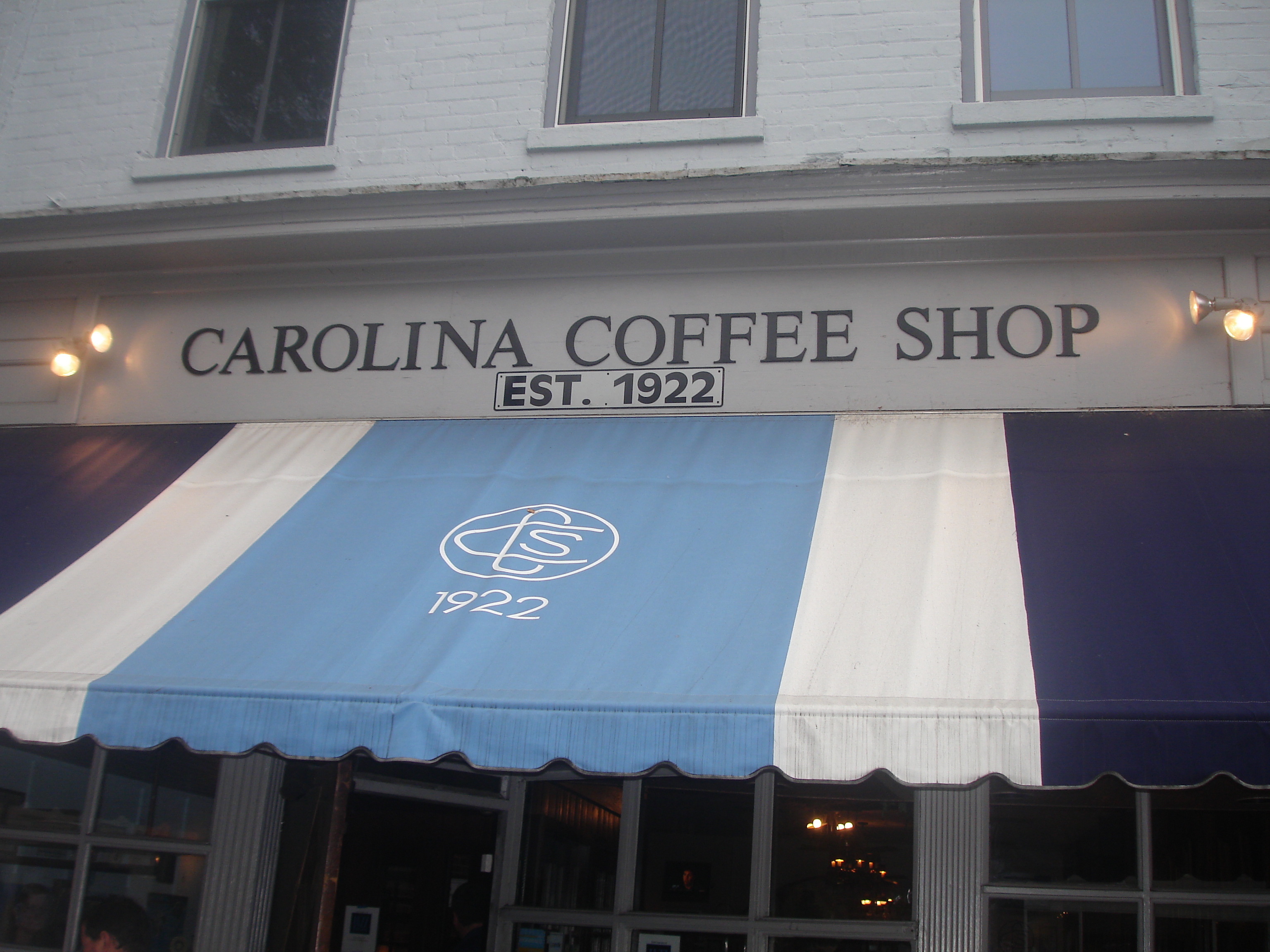
I was a waitress at the CCS in the late seventies while Byron Freeman owned it, and I’ve read that writer David Sedaris was also one of his employees a few years earlier. Serving breakfast, lunch and dinner as classical music played in the background, the Carolina Coffee Shop was a coffee shop before coffee shops were cool. Graduate students hung out there in groups or alone; couples went there on dates, and all kinds of students and families waited in line for a table on weekend mornings. I worked twenty hours or so a week and once served Chapel Hill visitor Alan Alda and some of his friends.

For a time, I juggled shifts at the CCS and Spanky’s to make as much money as I could while a full-time student at the university. Before we graduated, both my husband and I also worked (at different times) at another restaurant, the Country Squire, a steakhouse located between Chapel Hill and Durham; it was closed and torn down when I-40 was built where it stood.

I was able to go to France for my junior year and attend Université Paul Valéry because I was charged North Carolina, in-state tuition. Though I traveled throughout that year, I did it cheaply and watched my expenses. I never even considered going into debt to go to college, and I didn’t know many students who did.

Now, graduating with a college loan to pay off is almost ordinaire. I find that very troubling and wonder how people deal with it. When my husband and I graduated in the early 80s, we had little money but no debt. We got jobs, lived on a shoestring, and got married young, happy to be together and independent. With college costs so high today, who can work through college, pay for most of it themselves and graduate in four years with no debt? There just doesn’t seem to be a good raison why things have to be the way they are.*

When I was a student, few UNC dorms had air conditioning, not everyone owned a typewriter (I didn’t), and Michael Jordan played in Carmichael Auditorium. Professors were paid less and worked more, and fewer administrators filled offices. I suppose things have really changed.

One thing that hasn’t changed, though: you still have to pay back what you owe.

*Earlier this year, I read Higher Education?: How Colleges Are Wasting Our Money and Failing Our Kids—and What We Can Do About It by Andrew Hacker. The author examines the system and makes some very good recommendations. I hope things change.
Under the Radar: the middle child

With so many more families choosing to have just one or two kids, we middle children are getting squeezed out of the picture.

Despite the current assertion that “three is the new two,” the middle child is an anomaly these days. When I was growing up, a big family was five kids or more; three or four children was normal, and two or less was, well, small. When I got married, I wanted an even number of children (but more than two), and I’m grateful for my four. However, with twins on the first try, our third became the middle, despite my “plan.” And like his middle-child mom, he thrived in his own way, often flying under the radar.

What hasn’t changed about those of us who are neither the oldest nor the youngest child in a family? We usually leave home first, and we might even get married first (I did both). We don’t mind solitude (sometimes preferring it), and we both want and don’t want attention. We’re usually the “smart” different ones, and we like to do things our own way. While the oldest child parks lives according to the rules and the youngest seeks the spotlight (which might irritate us), we carve our own spot and make it work. We’re often the family’s peacemaker. When we choose our friends, we can be flexible; an oldest or a youngest works, but we also don’t mind one of our own — someone whom we understand completely. Ditto on choosing our mate.

It worries me (see earlier post on my glass-half-empty, worrier self) that there are so many fewer of us middle children today — at least in America and the West. What will it be like someday soon when everyone is either an oldest, youngest, or an only child? How will they all get along without us in their midst? And. . . will they miss us?

My middle child son and I are much alike, but of course we are also quite different. A few years ago he introduced me to the television comedy Modern Family, now a favorite of mine and his. We both recognized how much I was like the middle child, Alex. My older sister was like her older sister Haley, and my little brother was like Luke. It was almost uncanny. I’ve watched the show only on DVD and haven’t seen Season 3 yet, but I will soon.

Enfin, of course I can’t close without mentioning France. In July, we’ll visit deux familles français we have met through a student exchange program my daughter (the youngest) participated in during high school. Very unusual for the French, one family has five kids and the other has eight!

Vive la France!

Le verre est a moitié vide

I’m a glass-half-empty person, so no wonder I like the French.

France is a nation of pessimists, deux amies françaises averred to me this week. I asked both of them (who don’t know each other) just after I read the recent NYT piece by Jane E. Brody, A Richer Life by Seeing the Glass Half Full.

My husband, however, is a glass-half-full person– not surprising, since in many cases, opposites attract. I’ve always admired his persistence and motivation, two qualities Brody says that optimists usually exhibit. He tackles problems with a focus on solutions, looks for the good in stressful situations, and believes that somehow, everything will work out. Over the years we’ve been together, some of his positive attitudes have rubbed off on me — but not all.

I’m not always “No-we-can’t,” but of the two of us, he’s the idealist and I’m the realist (and, being me, I don’t mean that I’m a realist in a good way). I’m a worrier and always have been. Unlike Brody, I haven’t fretted over the social, political and societal issues that I couldn’t do very much about. I have fretted about family issues that I could do little or nothing to solve, plus all those other things that I could change or fix. And yes, rather than looking on the bright side, I have focused on the worst that can happen.

After reading the article, though, I decided to evaluate whether I’ve evolved from my natural negative tendencies — whether I’ve fait de progrès. As my children grow into adulthood, I think I have, at least as a mom. As a writer, I believe that I have, as well. It’s still sometimes a struggle. I’m not always inspired, but I keep trying, keep writing and keep reading. Developing habits and a routine has helped, which I’ll explain in a future post. Watching and trying to emulate my husband’s work ethic and attitudes has helped a lot, and so has stepping back to focus and re-focus on my goals.

Can I change into a glass-half-full person? I’m working on it. Optimistically, I googled the phrase and discovered a new restaurant to try the next time I’m visiting Chapel Hill: Glasshalfull located in Carrboro, N.C., the town next door. What a nice surprise — and maybe a way to pursue that richer life.

Les lettres

In my novel, the protagonist and her boyfriend (for now, I’ll call them by les pronoms français, Elle and Il*) exchange a lot of letters.

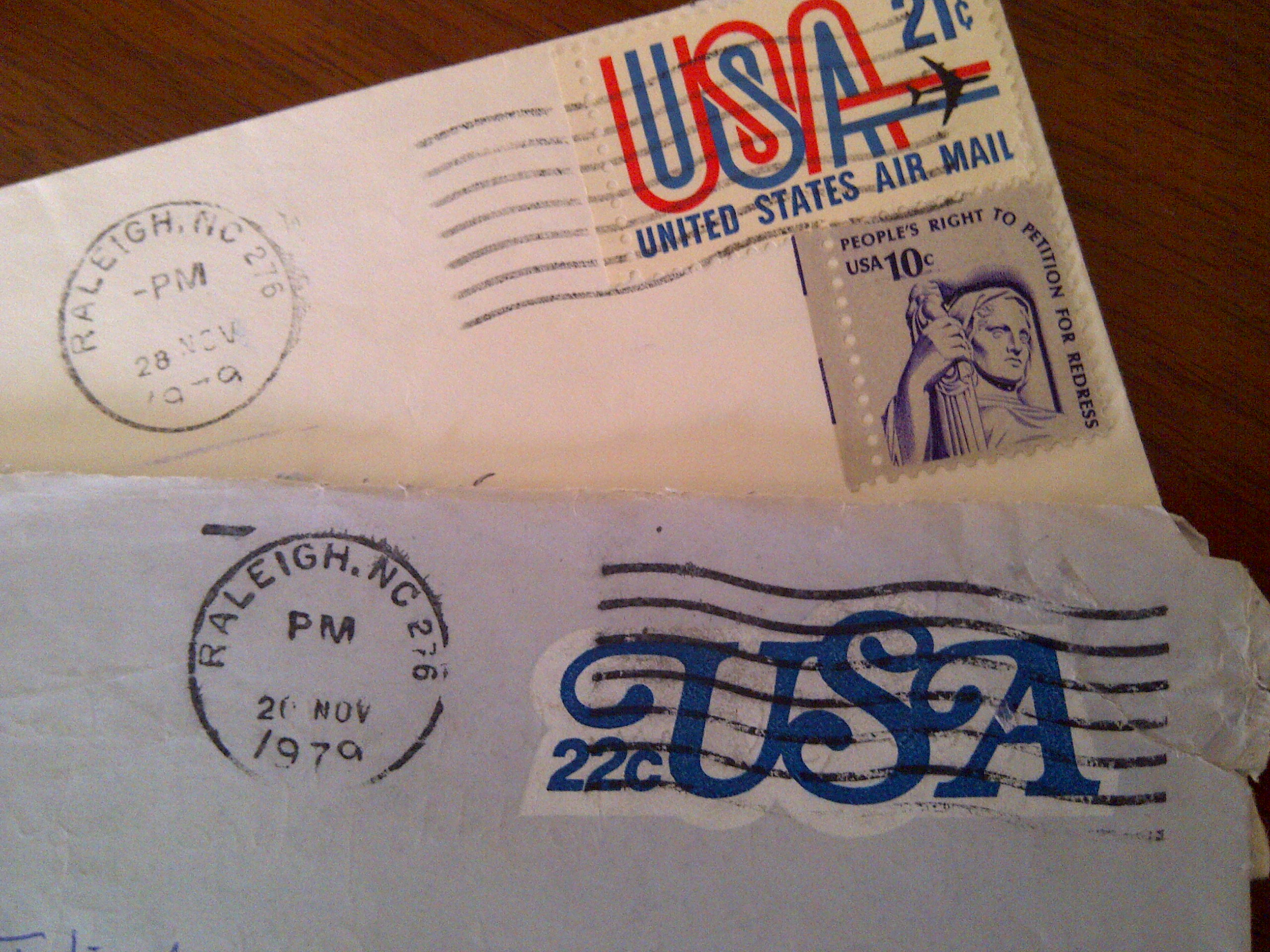
Elle has to wait weeks before she receives her first letter from Il — even though he writes to her the day she leaves the U.S. for France, his letter takes that long to arrive. She answers it, but the two don’t wait for the next letter from the other in order to write. In fact, during the year, Il writes to Elle at least once a week, and she writes to him almost as often. They talk on the telephone less than once a month, because phone calls are very expensive, and difficult to make.

How things have changed!

Neither Elle nor Il could imagine writing letters (emails), texts, tweets or updates (let alone posting photos) that the other would be able to view immediately. And if they were able to Skype or Facetime, I dare say their story might have turned out quite a bit differently. Might have.

But they don’t even imagine doing those things. The fact that their handwritten letters have to travel over an ocean by U.S. airmail makes each piece of mail from the other treasured and special. That’s why Elle, at least, keeps all of Il’s letters. That, and also because Elle is the more sentimental.

The fact is (or, the story is), Elle and Il deal with being apart while in love without the ease and speed of today’s communication methods. They wait, hope, and long to hear from each other. They think about what they write down on paper, in ink — especially when using those blue 22 cent aerogrammes. They read between the lines. They (at least, Elle) analyze. They pour their hearts out to each other. Their letters are private.

They do talk on the telephone occasionally: when drama arises, and on Christmas, of course. But their letters continue.

Today, most of us don’t write letters like theirs. We still send cards (though I believe that’s declining) and sometimes we write “formal” handwritten notes. When we write on a device or a computer, do we write differently? I think we do. When responding to an email, we may still read between the lines, but we almost have TMI — we even know the time it was written. We know our messages can be forwarded and shared and therefore, public. We are careful in what we say as a result.

Remember the letter that Elizabeth receives from Mr. Darcy in Pride and Prejudice, the one that he hand-delivers? Maybe the methods lovers use to express themselves in writing have changed. But I’m not sure that what they say has. . .

* names will be revealed later this year when the novel is released.

La photographie


Now there’s something that has changed.

If you’re older than my teenage daughter, you may remember when taking photos was a very different process than it is today. Like so many people now, I enjoy the convenience of taking pictures with my phone or my camera (which has many features I haven’t taken the time to learn). I’m happy that I can view my photos immediately, delete the ones I don’t like, and crop lots of others. I love not having to print (or pay for) them unless they have a physical destination. And I’m grateful to be able to send pictures so easily to friends and family.

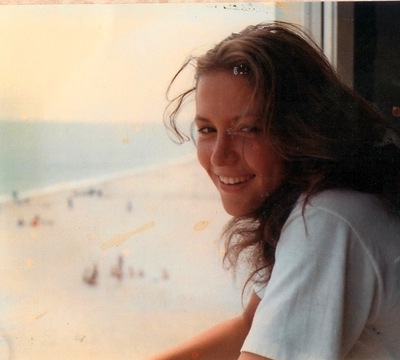
It wasn’t always this way. During my time in France many years ago, my girlfriends and I took very few photos, the main reason being that it was expensive. Taking pictures was reserved for important moments and unusual, beautiful scenes. Of course, the whole year was full of both, but, being young, we didn’t realize that. However, one day, Alison took a snapshot of me in a presque everyday moment, looking out over our  4e à droit (is it à droit, or just droit?) apartment terrace at the beach and the Mediterranean Sea.

“Look at me, Jules,” she might have said. “If this comes out, I’ll give it to you and you can send it to your boyfriend back home.”
Which I did — in an envelope, through the mail.

He kept it, and what you see above is a scan of that photo — something neither of us could imagine at the time.

Technology has changed the way we take pictures and our ability to share them, and I wonder if, in the process, it’s made them somewhat less important. A picture captures a moment in time. With so many pictures being taken now, are we mélanger-ing the moments into one big blur that might be better recorded in a video? Or are we losing those moments in a sea of other, less important ones?

What hasn’t changed about la photographie are the moments. I have boxes containing hundreds of photos of my family, the best ones preserved in scrapbooks and albums, chronicling the years and telling a story. Now I keep them on a “device” — able to be modified or deleted.

I’m glad the moments they record can never be lost or changed.

En attendant — Waiting

Oh, the Places You'll Go!I’ve been waiting to do this for a long time.

I don’t mean, waiting to write a blog — although I hope I haven’t waited too long to do that. (About ten years ago, someone close to me suggested I start blogging. I didn’t take her very good advice, but a zillion other people did.)

No, I mean waiting to go back to France.

Like many others, I spent a year of college as an exchange student. (See stuffwhitepeoplelike.com #72 Study Abroad.) This year my husband and I will be celebrating a milestone anniversary, so we decided to take a trip to France. We’ll spend a week in the south, the weekend in Lyon, and the next week in Paris. My husband has been to France only once, going to Paris for a few days on business. So, over the last several months, I’ve been planning our trip and working on my French (my fluency has waned due to lack of practice) by attending weekly tutoring sessions with Madame Marie-Hélène.

Alors, back to the subject of waiting: I waited a long time to write a novel, and then I did it. I waited a long time to re-learn to speak French, and then I did it. I’m not waiting any longer to write this blog. Because of some of the things I rediscovered while writing my first novel and while working on the next, this blog will focus on the following theme:

The more things change, the more they remain the same. En francais: Plus ça change, plus c’est la même chose.

And one thing that doesn’t change is the necessity of waiting. Sometimes we have to wait, but sometimes we choose to wait. Since I’m starting this blog in the midst of the graduation season, some favorite lines from Dr. Seuss’ Oh, The Places You’ll Go! come to mind, about “The Waiting Place:”

“…for people just waiting.

Waiting for a train to go or a bus to come, or a plane to go, or the mail to come, or the rain to go, or the phone to ring, or the snow to snow, or waiting around for a Yes or a No, or waiting for their hair to grow.

Everyone is just waiting.

Waiting for the fish to bite, or waiting for wind to fly a kite, or waiting around for Friday night, or waiting, perhaps, for their Uncle Jake, or a pot to boil, or a Better Break, or a string of pearls, or a pair of pants, or a wig with curls, or Another Chance.

Everyone is just waiting….”

I’m not staying in The Waiting Place anymore. Are you?

Create a website or blog at WordPress.com

Up ↑