D’habitude: routine

I like (and don’t like) my routines and habits.

A few weeks ago, I read on my iPad The Power of Habit: Why We Do What We Do in Life and Business by Charles Duhigg. You may have heard of the book — published in late February, it has remained on the New York Times non-fiction best-seller list for months. I don’t always read best-sellers (and let’s don’t even talk about the current best-selling fiction books). But this book was appealing, not because so many other people found it so, but because I was ready to examine my own habits, to keep what worked and to change what didn’t.

I’m still working on some of the changes, but I’ve successfully adopted a few of the more basic (and very important) ones. I’ve cut out almost all (diet) Cokes from my diet — for those of you non-Atlantans, Cokes = all carbonated drinks. I’ve shifted my choices of what to eat for lunch at home from whatever we had in the fridge (like leftovers) to what I ate every day as a younger mom: albacore tuna fish or cottage cheese-and-fruit — and when eating out, I’ve made much healthier menu selections. I’ve increased my weekly cardio routines from three times a week to five or six.

I’ve been doing these things not quite long enough yet for them all to feel like habits; they still feel like choices, causing me to think (see book mentioned above). But with each day, I’m getting closer, and as my husband says, it can be all right to make a different choice occasionally, as long as you get right back on your routine afterward. That’s key for me. Aside from health-related issues, however, I’ve also tried to apply what I learned about routines to my work life as a writer.

In some ways that’s been difficult, but in other ways it hasn’t. When I sat down one August to write the first draft of my first novel, d’habitude I worked every weekday from 9 am to 1 pm straight; I was finished by May but didn’t realize that revisions would take just as much work and a lot longer. Much as I know what daily and weekly habits work well for me, and even though I feel comforted (less mentally stressed?) by them, I also feel rather constricted by them. There’s a part of me that’s figure-it-out-as-I-go and, well, more creative (which is essential when writing fiction). My spontaneous, imaginative, only-as-organized-as-I-have-to-be side has always battled against my productive, organized, good-habit-keeping side. This was even the case when my children were little and my occupation was stay-at-home mother — with four kids, I had to be organized. However, I fought and surrendered to that necessity. Hopefully, no one noticed.

Now that I’m writing full-time, I’ve found that I can balance creativity and productivity while making an effort to re-institute my working routines. Dialogue and scenes (the fun part) appear in my head and on the page more easily once I’ve got the story’s plot fine-tuned. My game plan can and does change along the way, but it keeps me focused when the words aren’t coming.  Aside from a two-week vacation with mon mari this summer, I’ll continue my work schedule even when life’s demands get in the way. And I’ll enjoy (more than he will, I fear) the break in routine. I’ll get to think more, I hope, while maintaining my healthier habits.

I’d better bring some paper, a pen, and my iPad!

Les lettres

In my novel, the protagonist and her boyfriend (for now, I’ll call them by les pronoms français, Elle and Il*) exchange a lot of letters.

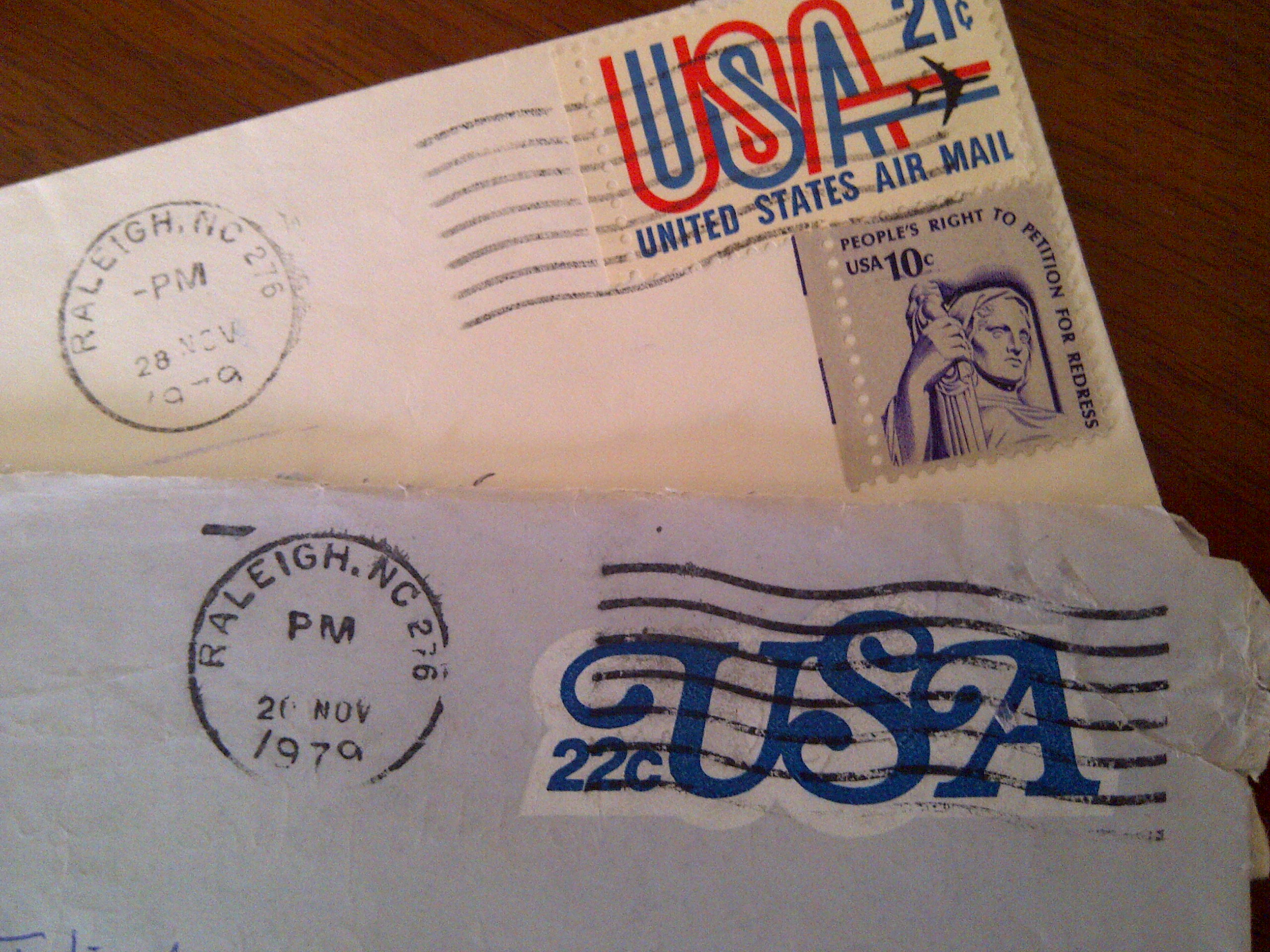
Elle has to wait weeks before she receives her first letter from Il — even though he writes to her the day she leaves the U.S. for France, his letter takes that long to arrive. She answers it, but the two don’t wait for the next letter from the other in order to write. In fact, during the year, Il writes to Elle at least once a week, and she writes to him almost as often. They talk on the telephone less than once a month, because phone calls are very expensive, and difficult to make.

How things have changed!

Neither Elle nor Il could imagine writing letters (emails), texts, tweets or updates (let alone posting photos) that the other would be able to view immediately. And if they were able to Skype or Facetime, I dare say their story might have turned out quite a bit differently. Might have.

But they don’t even imagine doing those things. The fact that their handwritten letters have to travel over an ocean by U.S. airmail makes each piece of mail from the other treasured and special. That’s why Elle, at least, keeps all of Il’s letters. That, and also because Elle is the more sentimental.

The fact is (or, the story is), Elle and Il deal with being apart while in love without the ease and speed of today’s communication methods. They wait, hope, and long to hear from each other. They think about what they write down on paper, in ink — especially when using those blue 22 cent aerogrammes. They read between the lines. They (at least, Elle) analyze. They pour their hearts out to each other. Their letters are private.

They do talk on the telephone occasionally: when drama arises, and on Christmas, of course. But their letters continue.

Today, most of us don’t write letters like theirs. We still send cards (though I believe that’s declining) and sometimes we write “formal” handwritten notes. When we write on a device or a computer, do we write differently? I think we do. When responding to an email, we may still read between the lines, but we almost have TMI — we even know the time it was written. We know our messages can be forwarded and shared and therefore, public. We are careful in what we say as a result.

Remember the letter that Elizabeth receives from Mr. Darcy in Pride and Prejudice, the one that he hand-delivers? Maybe the methods lovers use to express themselves in writing have changed. But I’m not sure that what they say has. . .

* names will be revealed later this year when the novel is released.

Create a website or blog at WordPress.com

Up ↑